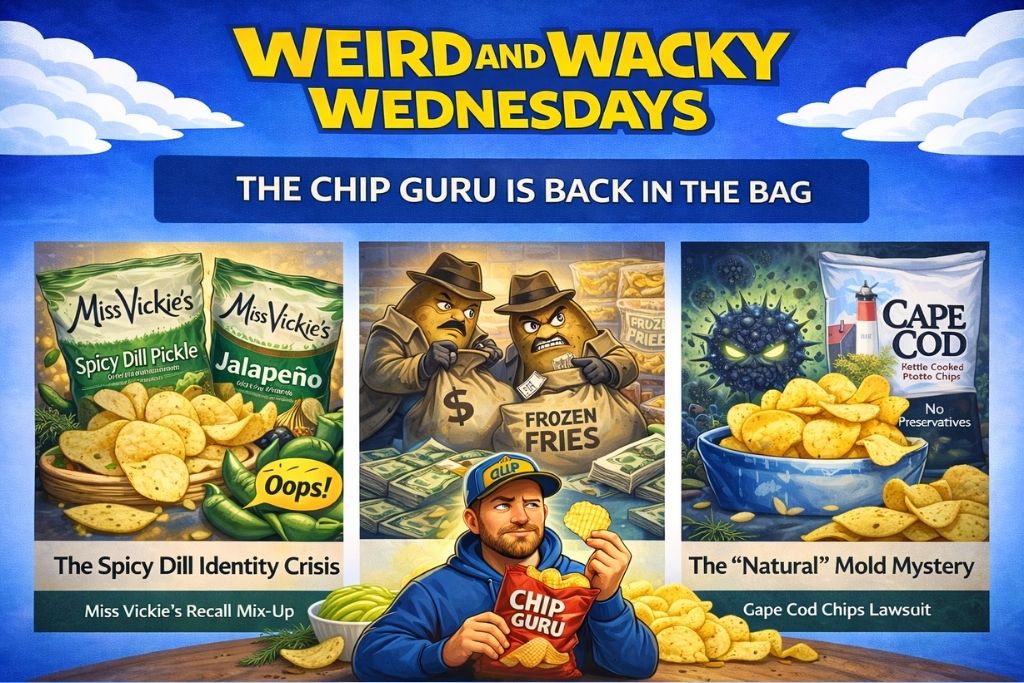
This week on Weird and Wacky Wednesdays: The Chip Guru is Back in the Bag
It’s been a minute since I’ve donned my official Chip Guru hat, but the legal world has been suspiciously salty lately. If you thought the only drama in the chip aisle was whether to pick Ketchup or All-Dressed, think again. From secret cartels to microscopic mold, the courtroom is currently crunchier than a kettle-cooked chip.
This week on Weird and Wacky Wednesdays we look at three stories proving that when it comes to potato chips, the law is never far behind.
The Spicy Dill Identity Crisis
We start with a classic case of “You had ONE job.” In March 2026, Frito-Lay issued a high-priority recall for Miss Vickie’s Spicy Dill Pickle chips. Why? Because the bags were actually full of Jalapeño chips.
Now, for most of us, that’s just a spicy surprise. But in the eyes of the law (and the FDA), it’s a major liability. The Jalapeño seasoning contains milk, an allergen nowhere to be found on the Dill Pickle label. It’s a literal flavor-swap nightmare that reminds us: in the world of food labeling, an “oops” can lead to a class-action “ouch.”
The Great “Potato Cartel”
You’ve heard of the “Maple Syrup Heist,” but have you heard of the Potato Cartel? Across North America, major players like McCain and Cavendish are currently facing massive antitrust lawsuits.
The allegation? These industry giants supposedly used sophisticated data-sharing to fix prices, allegedly hiking the cost of frozen potato products by nearly 50% while their own costs were dropping. If true, your late-night poutine and morning hash browns are the victims of a high-stakes conspiracy. I guess when you control the potatoes, you control the world.
The “Natural” Mold Mystery
Finally, we have the case of Cape Cod Potato Chips and the “Natural” labeling war. A New York lawsuit is currently taking aim at the “No Preservatives” claim on the bag.
The plaintiff’s argument is a weird one: the chips contain citric acid, which sounds natural enough, right? Wrong. The lawsuit alleges that mass-produced citric acid is actually derived from a specific type of black mold (Aspergillus niger). The court now has to decide: if your “natural” preservative comes from a lab-grown fungus, is the label a lie? It’s a deep-dive into chemistry that would make even a food scientist’s head spin.
The Chip Guru’s Verdict
When I look at the flavour profile of these cases, there’s a lot to unpack. We have the sharp, vinegar-like sting of a mislabeled dill pickle, the heavy, starch-filled weight of a corporate conspiracy, and that lingering, slightly bitter aftertaste of synthetic citric acid.
It’s a complex palate of litigation. Rating this batch of legal drama on the official Chip Guru scale, I’m giving these stories a solid 8.3/10. They’ve got great structural integrity and just enough flavour angles to keep things interesting in the courtroom.
A Look Back: The Legend of the Saanich Bandits
Potato chips have often been the source of weird and wacky stories, and I often think of a local one from right here in B.C. back in 2012.
You might remember the two university students who broke into a garage in Saanich just to liberate a single bag of Zellers BBQ chips. The police description of those “effervescent” chips remains a highlight of Canadian chip history.
These two learned their lesson the first time out. The justice system did its job. By now, they must be older, wiser, and likely have kids of their own who know that if you want a snack, you should ask nicely or be prepared to pay the potato cartel.
Until next week, stay salty my friends.
