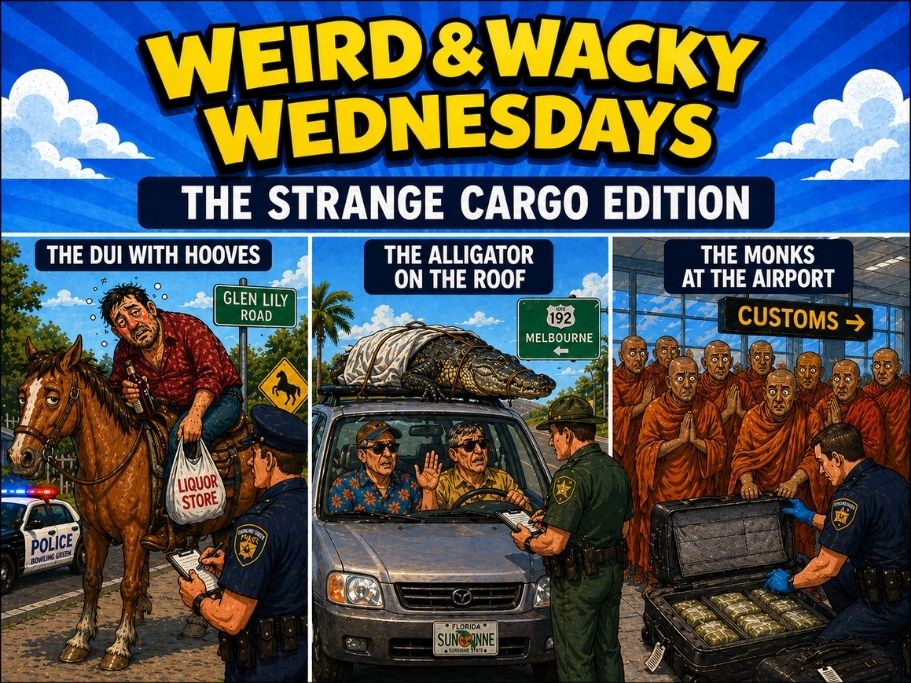
This week on Weird and Wacky Wednesdays: The Strange Cargo Edition
Every so often the news cycle delivers a run of stories that all seem to circle the same idea, and this past month gave us a good one. The theme is cargo. Specifically, the kind of cargo people are not supposed to be moving, on the kind of conveyance they probably should not be using to move it. We have a horse, a deceased alligator, and 22 Buddhist monks with 242 pounds of explanation to do at customs. None of these people were thinking about Canadian law when they did what they did, but each story is a useful reminder of how Canadian law would have treated them if they had tried any of this here.
Let’s start with the horse.
The DUI With Hooves
On a Thursday afternoon in late March, a Bowling Green, Kentucky police officer noticed a horse trotting down Glen Lily Road with a man slumped on its back. The horse was the calmer of the two. The rider, 48-year-old Jorge Luis Hernandez, was reportedly leaning hard to one side, smelled strongly of alcohol, had bloodshot eyes, slurred speech, and was traveling on the sidewalk. He told police he had just left a liquor store and was on his way home. The bag from the liquor store was still tied to the saddle.
Hernandez was charged with operating a non-motor vehicle under the influence. Kentucky’s legislature, like most legislatures, has decided that a non-motor vehicle is more or less anything that can be ridden and that does not have a fuel tank, and a horse comfortably qualifies. The horse was not arrested. The horse, by all accounts, was doing fine.
For Canadian readers wondering whether this could happen here, the answer is probably not, at least not as a Criminal Code impaired driving charge. The federal definition of “conveyance” is broad, but it specifically carves out anything powered by muscle. A horse is, by any reasonable definition, powered by muscle. That puts horseback riding outside the impaired operation provisions of the Criminal Code.
The B.C. Motor Vehicle Act is a slightly different question. The Act’s definition of “vehicle” is wide enough that a horse and rider could arguably fit, but a horse is not a “motor vehicle,” because a motor vehicle has to be self-propelled, and self-propelled means an engine, not lunch. So the impaired driving provisions that key off of “motor vehicle” do not apply either. There may be some scope for a provincial offence depending on how the section is worded and how it has been interpreted, but in 26 years of practice I have never seen a case in this country where someone was charged with impaired driving on horseback, and I am not aware of a reported decision on it. The realistic outcome here would be a public intoxication ticket under provincial liquor legislation, and possibly a stern conversation with the horse’s owner. A horse pulling a wagon could invite a different analysis, because once you are sitting on a wheeled vehicle with reins in your hands, the legal picture starts to look more like driving and less like riding.
The Alligator on the Roof
A couple of weeks later, on a stretch of U.S. Highway 192 near Melbourne, Florida, deputies pulled over a vehicle with a dead alligator strapped to the roof and a bedsheet draped over it for the sake of decency. Behind the wheel were two tourists, Anthony Buhl, 56, of New York City, and March Wallin Chadwick, 57, of Chattanooga, Tennessee. They told deputies they had picked up the alligator after finding it as roadkill, and that they were on their way to have it taxidermied. Witnesses had reported the rooftop reptile traveling through Celebration and St. Cloud, which is exactly the kind of sentence I never expected to type.
Both men admitted to deputies that they knew it was illegal to take possession of an alligator. They were charged with felony wildlife offences and have since bonded out.
The legal point worth flagging here is that wildlife statutes generally do not care whether you killed the animal yourself or simply found it lying there. Possession is possession. If the rule were any softer, every poacher would magically transform into an unlucky motorist who happened to come across the same animal at the same convenient moment. The “I found it like that” defence is not a strong one, especially when the discovery is on the way to a taxidermist.
The Monks at the Airport
The third story is breaking as I write this. Sri Lankan authorities arrested 22 Buddhist monks at Bandaranaike International Airport last week after officers found cannabis hidden inside false-bottom compartments in the group’s luggage. The total seizure was about 110 kilograms, or roughly 242 pounds, with an estimated street value of more than $3.4 million. Police are calling it the largest drug bust in the airport’s history.
The monks had reportedly been on an all-expenses-paid four-day trip to Thailand. A 23rd monk who had come to the airport to pick the group up fled when he heard about the arrests, and was caught a few days later in a Colombo suburb. According to the police, that 23rd monk had told the rest of the group that the parcels in their bags were donations and had not mentioned what kind.
If the monks genuinely did not know what they were carrying, that fact matters. In most criminal systems, including ours, the Crown has to prove that the accused knew, or was wilfully blind to, the nature of what they had. The doctrine of wilful blindness is the one to watch in a case like this, because it covers the situation where someone has a strong suspicion that something is off and deliberately decides not to look. Each monk’s case will rise or fall on what they were told, what they saw, and how reasonable it was to believe the story they were given. Sri Lankan drug law is also strict, with penalties that can include long prison sentences.
The Common Thread
What ties these three stories together is the strange shape that “cargo” can take when the law gets involved. Sometimes it is the rider on top of the animal, sometimes it is the animal on top of the car, and sometimes it is the contents of two dozen suitcases. Whether any of it is criminal in a given country depends on the wording of statutes that were almost never written with these specific facts in mind. A Kentucky non-motor vehicle DUI law will catch a man on a horse. A Canadian impaired driving prosecution will not. A Florida wildlife statute will catch you for a roadside alligator pickup. Sri Lankan drug law will catch you for what is in your luggage, regardless of what you were told it was.
It is a quiet reminder that the most ordinary-looking trip can become a very bad day at the side of the road. A liquor store run, a vacation drive through Central Florida, a religious retreat to Thailand. None of these started out as a court file. All three ended as one.
See you next week.
