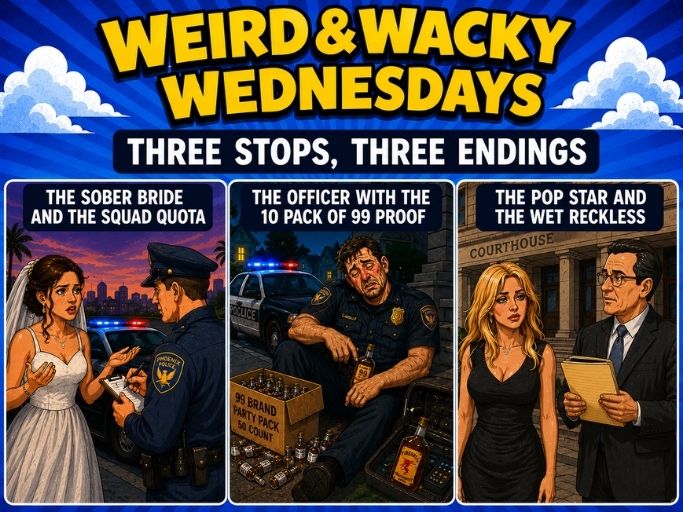
This week on Weird and Wacky Wednesdays: Three Stops, Three Endings
Most DUI investigations starts in roughly the same place. A car drifts, an officer pulls in behind, a window comes down, and the next thing you know there is a breath test and a file that will follow somebody around for years. After that, though, the path the case takes can go almost anywhere.
This week features three stops that ended in three very different places. One produced a charge the breath machine flatly refused to support. One produced a charge against the officer himself, complete with a bag of high proof shooters in the passenger seat. And one produced a plea deal so famously Californian that it has its own nickname.
A grab bag of cases, but all from the same opening scene.
The Sober Bride and the Squad Quota
In Phoenix, the bride got into the car the day after her wedding. By the time she got out of it she had been arrested for driving under the influence, despite blowing a 0.000, despite passing her field sobriety tests, and despite a blood draw that came back negative for both alcohol and drugs. A triple zero, in DUI math, is supposed to mean you go home.
Brianna Longoria did not go home. She went to a Phoenix jail cell, missed part of her honeymoon, and (according to a lawsuit filed against the City of Phoenix and the officers involved) had her cancer treatment delayed and her nursing studies interrupted. The original stop, for allegedly running a red light and a defective taillight, was contradicted by the responding officer’s own body camera footage.
The most striking part of the lawsuit is not the bride’s blood alcohol of nothing at all. It is what a second officer captured on the bodycam back at the precinct, when he is heard worrying out loud that “they’re gonna kick me off squad if I don’t get a DUI.” A stakeout at a Melrose bar strip the night before had turned up only designated drivers. The lawsuit alleges DUI quotas, and that the responding officer fabricated impairment indicators (glossy eyes, failed sobriety tests, the usual roadside hits) to make the file fit the number.
In Canada, a fabricated set of grounds for a roadside breath demand would be a Charter problem almost immediately. The right against arbitrary detention under section 9 and the right against unreasonable search and seizure under section 8 are both engaged the moment an officer invents the foundation for a stop. The remedy tends to be exclusion of the breath samples and a stay of the charge. There are targets, at least in B.C. but not quotas.
The Officer With the 10 Pack of 99 Proof
The next stop involved a fellow officer rather than a civilian. On March 9, an Anchorage Police Department patrol officer named Charles Bowser parked his department issued, fully marked patrol car at high speed in front of the home he was renting, slumped over on the front steps, and went unconscious. The off duty officer who lived in the upstairs unit, who happened to be his landlord, called a supervisor.
When other officers arrived, they could not wake him up. They called medics. Bowser’s blood alcohol came back at 0.293, more than three times the legal limit in Alaska. The dashcam in his own patrol car, helpfully recording the whole thing, showed him driving north of 80 mph, narrowly missing a guardrail, drifting in and out of lanes, and rolling through stop signs on the way home.
In the front passenger seat: a 10 pack of 99 proof shooters, three already missing. In the trunk: an empty 99 Brand Party Pack box that had earlier contained fifty of those little bottles. In the weapon rack between the front seats, where a long gun is supposed to live: a nearly empty bottle of Fireball whisky. The earlier dashcam footage also picked him up leaving a liquor store with a brown bottle in one hand and what looked like a fresh package of shooters in the other.
Bowser was charged on April 29 and placed on administrative leave pending internal and external investigations.
In British Columbia, this scenario barely needs a defence lawyer to map out. Section 320.14 of the Criminal Code does not care whether the impaired driver has a badge in their wallet. An immediate roadside prohibition under the Motor Vehicle Act would have been more likely, however. The patrol vehicle would create its own separate headache, because a marked police cruiser is presumed to be in the lawful custody of an officer on duty, and a drunk drive home is its own significant internal disciplinary file in addition to the criminal one.
The Pop Star and the Wet Reckless
The last stop is the most famous, and ends with the most California of plea deals. Britney Spears was arrested after officers said she was driving her black BMW quickly and erratically on Highway 101, performed poorly on field sobriety tests, and appeared impaired by both alcohol and drugs.
On May 4, her lawyer Michael A. Goldstein appeared on her behalf, entered a guilty plea to reckless driving involving alcohol, and walked out of the courthouse without his client ever setting foot inside it. She received credit for one day in jail (the booking), 12 months of probation, a DUI class, and the standard state mandated fines.
The plea is what California prosecutors and defence lawyers call a “wet reckless.” It is a guilty plea to reckless driving under Vehicle Code section 23103, with a notation under section 23103.5 that alcohol or drugs were involved. The DUI charge under section 23152 disappears in exchange. The big advantages are no mandatory licence suspension, a shorter alcohol education program, and a shorter mandatory jail minimum. The catch, and the part defence lawyers always have to underline for the client, is that a wet reckless is priorable. If she is convicted of a DUI in the next ten years, she will be sentenced as a repeat offender.
There is no Canadian equivalent. We do not negotiate impaired driving down to a watered down version of itself with a parenthetical about alcohol. The closest local cousin is a guilty plea to a non Criminal Code offence under provincial driving legislation, and even those usually require some creative facts to support them. The American wet reckless gives an entire branch of plea bargaining a name. In Canada, we tend to argue technicalities and Charter applications instead.
The Common Thread
Three stops, three endings. One ended in a wrongful arrest lawsuit and an alleged quota system. One ended in the arrest of the officer making the stop, by his own colleagues, after he tried to drive home from a 99 proof party pack. One ended in a celebrity plea deal that protects a driving record from one of the worst weeks the year had to offer.
What ties them together is that the law of impaired driving still has more give in it than people think. The breath number is not the whole story. The badge does not exempt anybody. And the deal that can be negotiated depends as much on geography as it does on facts. The bride got a triple zero and a jail cell. The officer got a 0.293 and a colleague turning him in. The pop star got a plea deal with a nickname and 12 months of probation.
Three stops. Three results. Same stretch of road, more or less.
See you next week.
