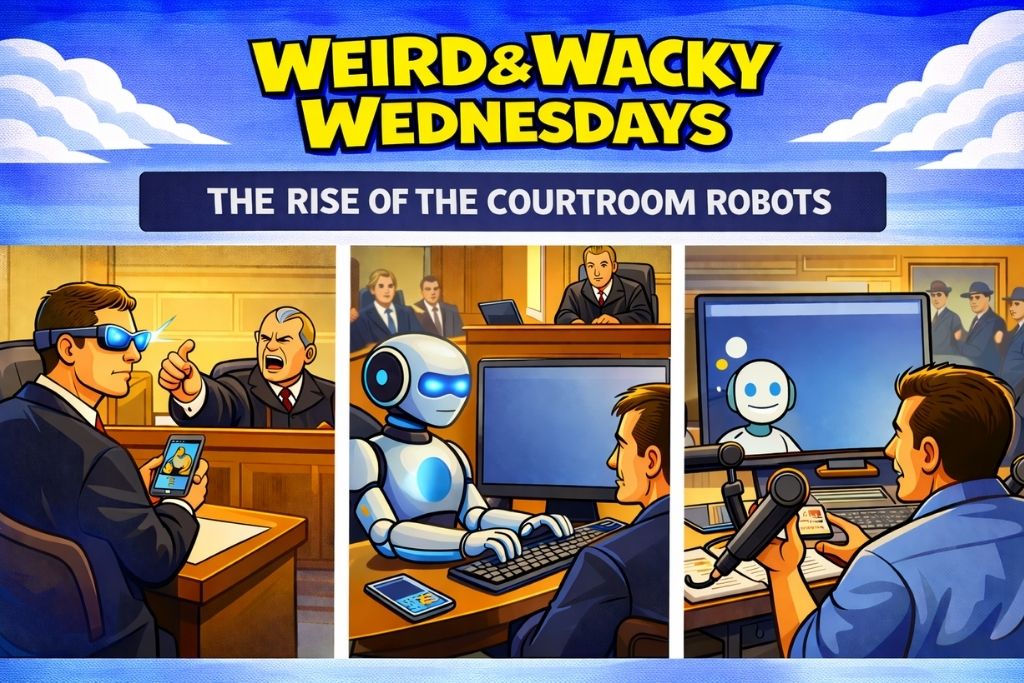
This week on Weird and Wacky Wednesdays: The Rise of the Courtroom Robots
The legal system is currently facing the AI technology transformation. Artificial intelligence is on the way to being a common tool in the courtroom. Lawyers and witnesses are finding new ways to use these tools in the hopes of gaining an advantage. However, these attempts often lead to obvious failures that highlight the gap between human judgment and a mere robot. The stories this week serve as a warning that the justice system relies on truth and transparency rather than clever shortcuts. And what might seem like a potential advantage can turn into a spectacular disadvantage.
The Case of the Magical Smart Glasses
A recent case in the London High Court demonstrated how far witnesses will go to avoid difficult questions. A fellow named Laimonas Jakstys was providing evidence in a business dispute. The judge noticed that the witness was behaving very strangely during his cross-examination. He wore smart glasses and paused for several seconds before answering each question. The judge became suspicious and ordered the witness to remove the glasses. He also ordered the witness to place his phone on the desk.
The situation became truly wacky when the phone suddenly started speaking. A voice began broadcasting answers to the legal questions out loud for the entire courtroom to hear. Jakstys claimed that he was merely trying to call a taxi. The court inspected the phone and found several active calls to a contact named Abra Kadabra.
The judge determined that someone was feeding the witness answers through his glasses. This incident destroyed his credibility and his evidence was completely rejected.
Legal Hallucinations in the District Attorney Office
Public officials are not immune to the temptations of fast technology. A District Attorney in Wisconsin recently faced a significant professional embarrassment after filing a legal brief. The prosecutor used an artificial intelligence program to write the document. The program performed its task quickly but it did not perform it accurately. The resulting brief contained several citations for legal cases that did not exist.
Fake citations are known as hallucinations. This is a well-known phenomenon at this point so it’s surprising that a lawyer would not be up on the risks of using AI for tasks such as this. The AI creates a realistic looking case name and citation to satisfy the user request.
The judge discovered the fraud when defence counsel could not find the mentioned cases. The judge expressed deep frustration with the lack of human oversight. This mistake led to the dismissal of the criminal case. It proves that the court requires real legal research instead of digital fabrications. This is one of the issues we see with people attempting to use AI as their lawyer. But there are other pitfalls.
Confessions to a Chatbot
Criminal defendants are also turning to AI for legal advice. A man in New York named Mr. Heppner recently faced fraud charges. He did not want to speak with a human lawyer immediately. Instead, he spent weeks having deep conversations with an AI chatbot named Claude. He shared his secrets and his defence strategies with the software. Federal agents eventually seized his computer and found the logs of these chats.
Now here is where it gets interesting. When you talk to your lawyer everything is protected by privilege but when you talk to AI?
The defendant tried to claim that these messages were protected by attorney-client privilege. He argued that the AI was acting as his legal advisor. The judge rejected this argument with a clear ruling. He stated that an AI is not a member of the Bar. Privilege only applies to human lawyers who are licensed to practice law. The prosecution now has a direct record of the defendant’s private thoughts and potential admissions.
This is a huge issue and will likely catch many people off guard in the years to come. Everything you say to an AI may be evidence used against you. Nearly everything you say to your lawyer in the context of an attorney-client relationship is generally protected by privilege.
We’re in the early days of people using AI in the justice realm. Certainly there is a role for these new tools but things are developing quickly and many people will find themselves badly served by their chatbots and then they will be featured on Weird and Wacky Wednesdays.
See you next week.
