supreme court

Silence Is Not a Neutral Option: WiCCD at the Supreme Court of Canada in Korduner (SCC 41737)
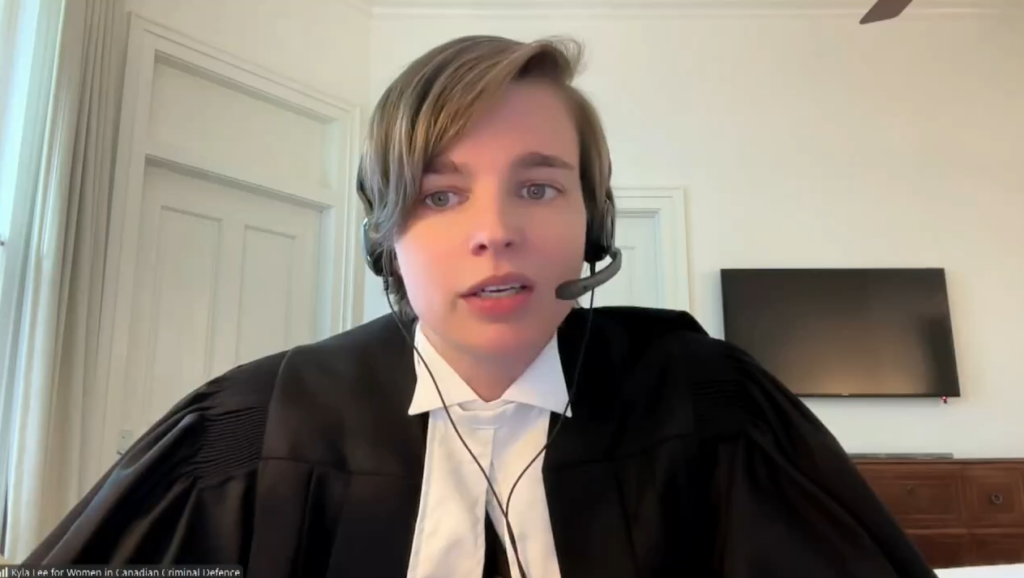
On February 17, 2026, I had the privilege of appearing before the Supreme Court of Canada as part of Women in Canadian Criminal Defence’s first intervention at the Court, in Megan Rae Korduner v His Majesty the King (SCC 41737).

WiCCD is an organization that has grown rapidly over the last four years, and it was a significant moment to bring the organization’s perspective to the Supreme Court, particularly in a case that raises fundamental questions about compelled speech, self-incrimination, and the right to silence under section 7 of the Charter.

Silence Is Not a Neutral Option: WiCCD at the Supreme Court of Canada in Korduner (SCC 41737) Read More »

Episode 437: Random Traffic Stops, Racial Profiling, and the Supreme Court’s Reckoning

The Supreme Court of Canada has heard a major case challenging the power of police to conduct arbitrary traffic stops in the face of mounting evidence of racial profiling. This week on Driving Law, Kyla Lee and Paul Doroshenko unpack what’s at stake — and what could finally change.

Episode 437: Random Traffic Stops, Racial Profiling, and the Supreme Court’s Reckoning Read More »

Episode 436: Supreme Court to Hear Impaired Driving Death Case and Mandatory Fines

The Supreme Court of Canada has agreed to hear a major impaired-driving case that could reshape how “causing death” offences are applied. In Episode 436 of Driving Law, Kyla Lee and Paul Doroshenko explain why the decision matters.

Episode 436: Supreme Court to Hear Impaired Driving Death Case and Mandatory Fines Read More »

Episode 435: Supreme Court Ends Mandatory Breath Test Challenge & Police Surveillance Concerns

The Supreme Court of Canada has declined to hear the Charter challenge to mandatory roadside breath testing, bringing a major legal battle to an end. In Episode 435 of Driving Law, Kyla Lee and Paul Doroshenko break down what happened — and what comes next.

Episode 435: Supreme Court Ends Mandatory Breath Test Challenge & Police Surveillance Concerns Read More »

The Supreme Court Rules on What the Crown Must (and Must Not) Prove in Impaired Driving Cases

On November 14, 2025, the Supreme Court of Canada (SCC) delivered its judgment in R. v. Larocque, 2025 SCC 36, a companion case to R. v. Rousselle, 2025 SCC 35. This ruling clarifies the Crown’s evidentiary burden when prosecuting the “80 and over” offence, focusing specifically on how much information about the alcohol standard used in breath testing must be proven at trial.

The case revolved around Stéphane Larocque, who was stopped at a sobriety checkpoint and subsequently charged with operating a motor vehicle with a blood alcohol concentration (BAC) equal to or exceeding 80 mg percent. At trial, the Crown introduced certificates from the qualified technician and two analysts to satisfy the preconditions required to utilize the statutory presumption of accuracy in s. 320.31(1) of the Criminal Code.

The issue before the SCC was technical but highly significant: Must the Crown prove the specific numerical target value of the alcohol standard used during the system calibration check to benefit from the presumption of accuracy for breath sample analysis results?

The Supreme Court Rules on What the Crown Must (and Must Not) Prove in Impaired Driving Cases Read More »

BC Supreme Court Chambers Consultation: What Lawyers Said—and What the Court Plans to Do

The BC Supreme Court recently asked for feedback on how to make chambers more efficient and accessible. Over a hundred lawyers and litigants responded. I took part in that process and offered several practical suggestions. The Court has now released its Summary of Feedback and many of the ideas I raised are reflected in it.

BC Supreme Court Chambers Consultation: What Lawyers Said—and What the Court Plans to Do Read More »

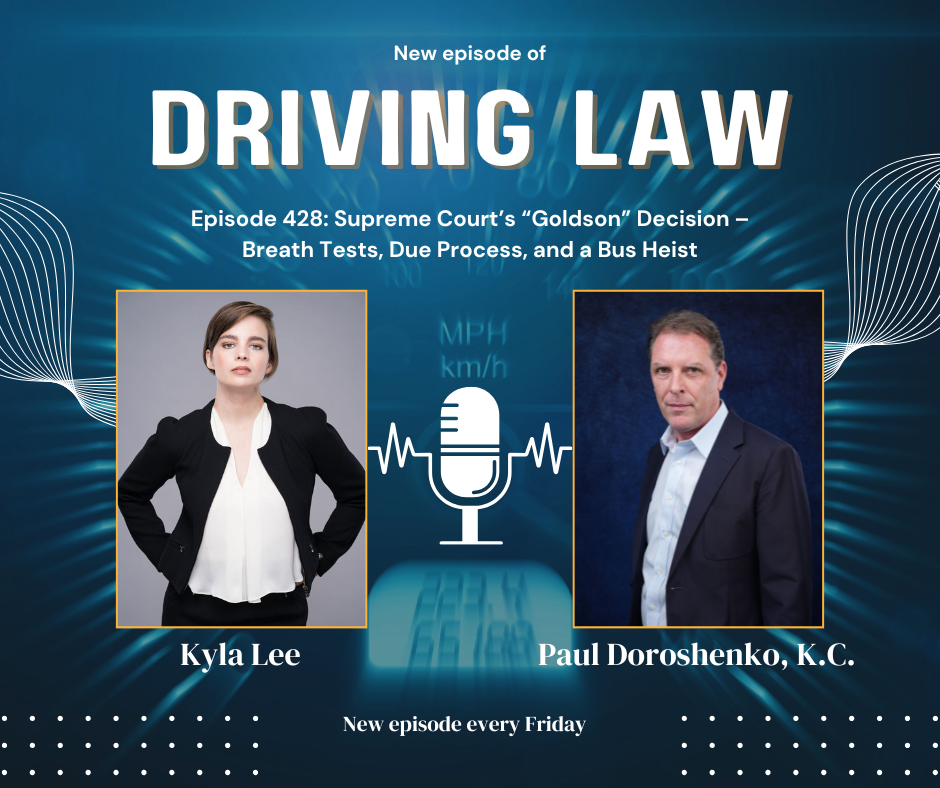
Episode 428: Supreme Court’s “Goldson” Decision – Breath Tests, Due Process, and a Bus Heist

The Supreme Court of Canada handed down decisions this week that mark a dark day for fair trial rights in Canada. In the Goldson line of cases, the Court ruled that prosecutors don’t have to file both the qualified technician’s and the analyst’s certificates for breath-test calibration — a shortcut that keeps key evidence out of reach for the defence.

Episode 428: Supreme Court’s “Goldson” Decision – Breath Tests, Due Process, and a Bus Heist Read More »

Indigenous Protesters: Cases That Should Have Gone to the Supreme Court of Canada, But Didn’t!

Welcome to “Cases That Should Have Gone to the Supreme Court of Canada, But Didn’t!”

In this episode, Kyla Lee from Acumen Law Corporation discusses the case of Angela Davidson, an Indigenous woman and former deputy leader of the Green Party, who was arrested twelve times during protests against development projects in British Columbia. After pleading guilty to breaching court orders, Davidson argued that her actions as a land defender should be viewed through the lens of her Indigenous identity—and that her obligation to the land should mitigate her sentence. The court disagreed. Leave to appeal to the Supreme Court of Canada was denied, leaving unresolved how Indigenous legal perspectives and obligations to land should be treated in sentencing.

Indigenous Protesters: Cases That Should Have Gone to the Supreme Court of Canada, But Didn’t! Read More »

Consultation with First Nations: Cases That Should Have Gone to the Supreme Court of Canada, But Didn’t!

Welcome to “Cases That Should Have Gone to the Supreme Court of Canada, But Didn’t!”

In this episode, Kyla Lee from Acumen Law Corporation discusses a case involving the Huron-Wendat First Nation and the Canadian government’s constitutional duty to consult. While the Nation’s main application—arguing they were not adequately consulted on a development project—was waiting to be heard in Superior Court, the government attempted to move forward with the project. The Huron-Wendat First Nation sought an interim stay to pause the project until the issue of consultation could be resolved. The court refused, and the Supreme Court of Canada declined to hear the case. This decision raises serious concerns about how Canada’s duty to consult is respected—or disregarded—in practice.

Consultation with First Nations: Cases That Should Have Gone to the Supreme Court of Canada, But Didn’t! Read More »

Kyla Lee in The CBA National: Supreme Court finds judge-only trials were acceptable during the pandemic

In a unanimous ruling, the Supreme Court of Canada has found that for trials held during the COVID-19 pandemic, it was acceptable for judges to consent to judge-only trials over the objections of Crown prosecutors to avoid creating delays. 

The Court’s reasoning, however, split 5-2 over where the line was when it came to the Crown’s prosecutorial discretion.

Charged with the second-degree murder of his spouse, accused Pascal Varennes’ trial was set for September 2020, when the pandemic was in full swing. In June 2020, he requested a judge-alone trial to avoid possible delays with a jury trial, which would breach his Charter right to be tried in a reasonable time. The Crown refused to consent, asserting that the public interest favoured a jury trial. However, the judge found the refusal was “unfair or unreasonable in the circumstances” and allowed the judge-only trial.

Kyla Lee in The CBA National: Supreme Court finds judge-only trials were acceptable during the pandemic Read More »

Scroll to Top
CALL ME NOW