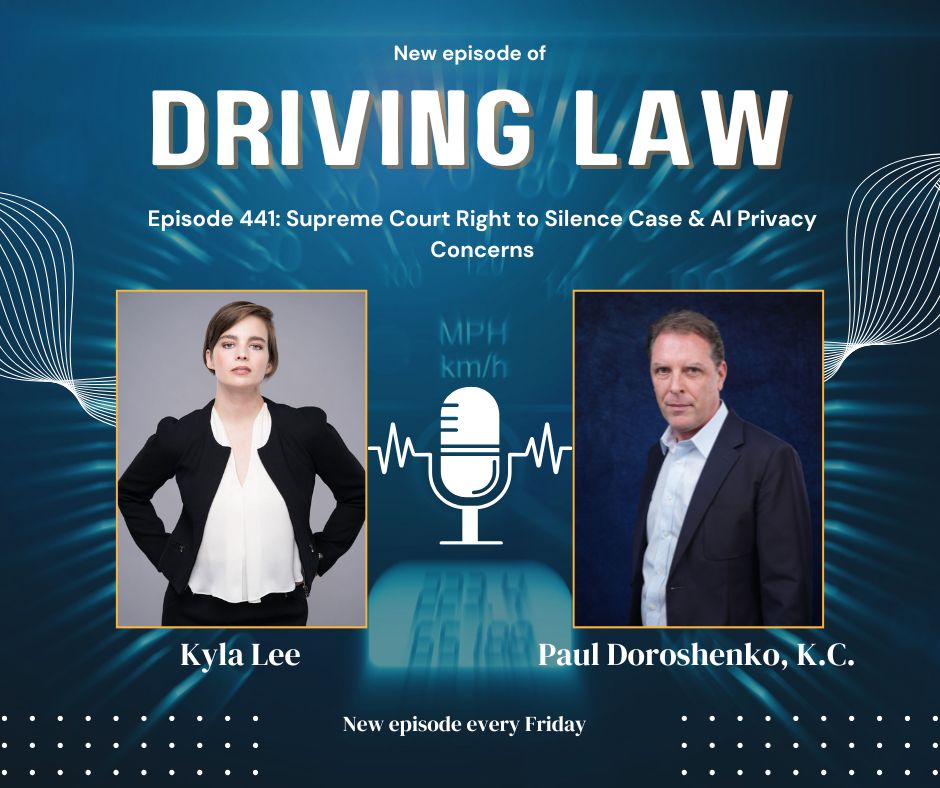
A new episode of Driving Law is now available.
This week, Kyla discusses appearing before the Supreme Court of Canada on behalf of Women in Canadian Criminal Defence in a case about compelled accident statements and the right to silence. The episode also examines privacy law, AI facial recognition, and the risks of expanding surveillance technology.
At the Supreme Court of Canada, the issue was whether drivers who are compelled by provincial motor vehicle legislation to provide accident information can have those statements used to further criminal investigations. The case raises concerns about fairness and the right against self-incrimination — particularly how roadside detention laws disproportionately affect women who may cooperate out of fear or social conditioning rather than free choice.
The discussion then turns to privacy and technology. The B.C. Court of Appeal upheld the Privacy Commissioner’s decision against Clearview AI, confirming that companies cannot scrape facial images from the internet and use them for law enforcement without consent. As AI-powered enforcement tools expand, these decisions become increasingly important for protecting drivers’ rights.
The episode also addresses privacy breaches tied to the Lapu-Lapu Day tragedy and what remedies may exist when sensitive information is unlawfully accessed.
Stream Episode 441 for the full discussion.
