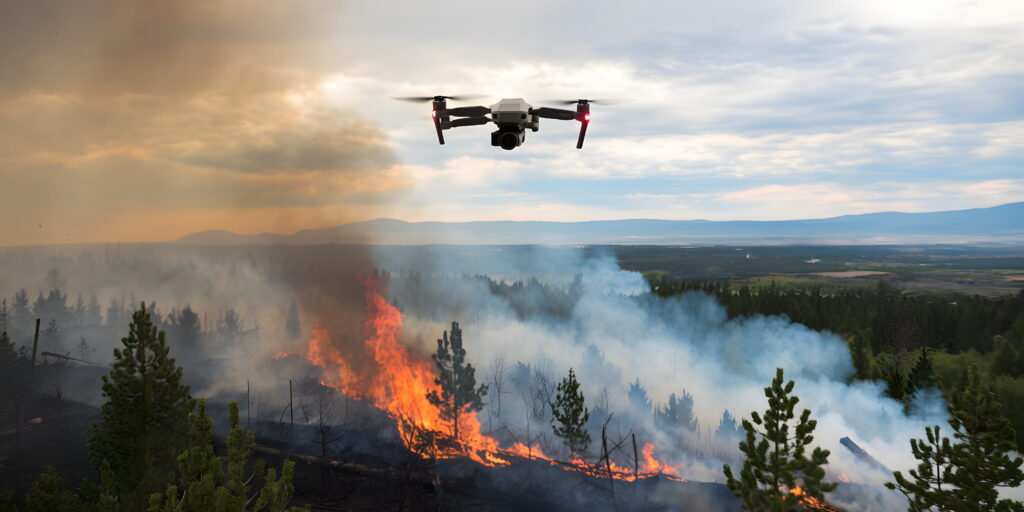
In R. v. Leippi, 2026 BCPC 26, the BC Provincial Court convicted a recreational drone operator of “interfering with fire control” under the Wildfire Act.
The case arose from the 2023 Kelowna wildfire. Mr. Leippi was operating a small drone from a boat on Okanagan Lake to capture footage of fire damage. A helicopter pilot who was bucketing water for wildfire suppression noticed the drone, became irritated by its presence, and briefly attempted to knock it out of the air with water before moving on. Conservation officers saw this and then seized the drone and charged Mr. Leippi.
At trial, the only question was whether Mr. Leippi’s operation of the drone “interfered” with fire control. The court concluded that it did.
So why was Mr. Leippi convicted?
The pilot testified that he felt “irritated” and “stressed” upon seeing the drone. He claimed that it distracted him from firefighting, and diverted his time and attention to trying to disable it. The judge reasoned that, during those moments, the pilot’s focus shifted away from firefighting and that this constituted interference with fire control. On that basis, the court found the interference was proven.
The court rejected Mr. Leippi’s claim that he believed there was no active firefighting in the area and found that, once he became aware of the helicopter and was asked to move by conservation officers, a reasonable person would have immediately grounded the drone rather than leaving it hovering near the water. Because he did not remove the drone right away, the court found he had not taken reasonable steps to avoid the harm.
Yes the harm of annoying someone who should be able to maintain focus on their job without being distracted by a drone they originally thought was a bird.
Yes, drones and firefighting aircraft are a dangerous combination. Yes, the goal of keeping airspace around active fire suppression operations free of interference is important. But,
This case raises a grave concern about how “interference” was conceptualized by the judge.
The court’s finding of interference turned significantly on the pilot’s personal emotional reaction to the drone. The pilot testified that the drone irritated him, that irritation led to stress, and that stress caused distraction. The chain of reasoning effectively made the drone operator responsible for the pilot’s emotions and the pilot’s choice to divert attention from his primary task to attempt to damage the drone.
The law should not function to make someone else responsible for a person’s failure to control their own emotions.
Interference ordinarily implies some objective obstruction or hindrance of an operation. Here, the interference flowed from a third party’s emotional response and discretionary reaction. The drone did not physically obstruct the helicopter’s water source. The pilot testified that he could and, in fact, did continue to operate safely. Boats in the area were not themselves an issue. Birds were not. He even thought the drone was a bird at first.
Instead, the interference arose because the pilot chose to react to something that irritated him, even attempting to damage or disable it, rather than simply gathering water and continuing his work.
Assigning foreseeability to that emotional reaction risks shifting liability from concrete interference to responsibility for another person’s subjective response.
If “interference” can be established because a trained and working professional becomes annoyed, stressed, and distracted by a person’s presence or conduct, the scope of regulatory and even criminal liability risks expanding beyond actual interference and into responsibility for another person’s emotional state.
Think about this in the context of obstruction of a police officer.
Obstruction focuses on conduct that actually hinders or obstructs an officer in the execution of their duty. Courts have long resisted interpretations that turn obstruction into liability for merely upsetting, irritating, or distracting an officer through conduct that is not itself obstructive. If an officer overreacts emotionally to behaviour and diverts themselves from their task, the law does not ordinarily treat that emotional reaction as something attributable to the person who triggered that feeling.
The concern in Leippi is that a similar logic could creep into other offences, where foreseeability becomes anchored not to objective risk, but to unpredictable emotional responses. Then the boundary between objective interference and subjective reaction becomes blurred. That risks creating liability not for what a person actually did, but for how someone else felt.
The better approach, and the one that fits more comfortably with established principles of foreseeability and responsibility, is to anchor interference in objective hindrance or a realistic, inherent risk created by the conduct itself. Drones near firefighting aircraft clearly create these risks. The reasoning becomes more fragile when liability turns on the fact that a third party became annoyed and made a discretionary choice to react.
