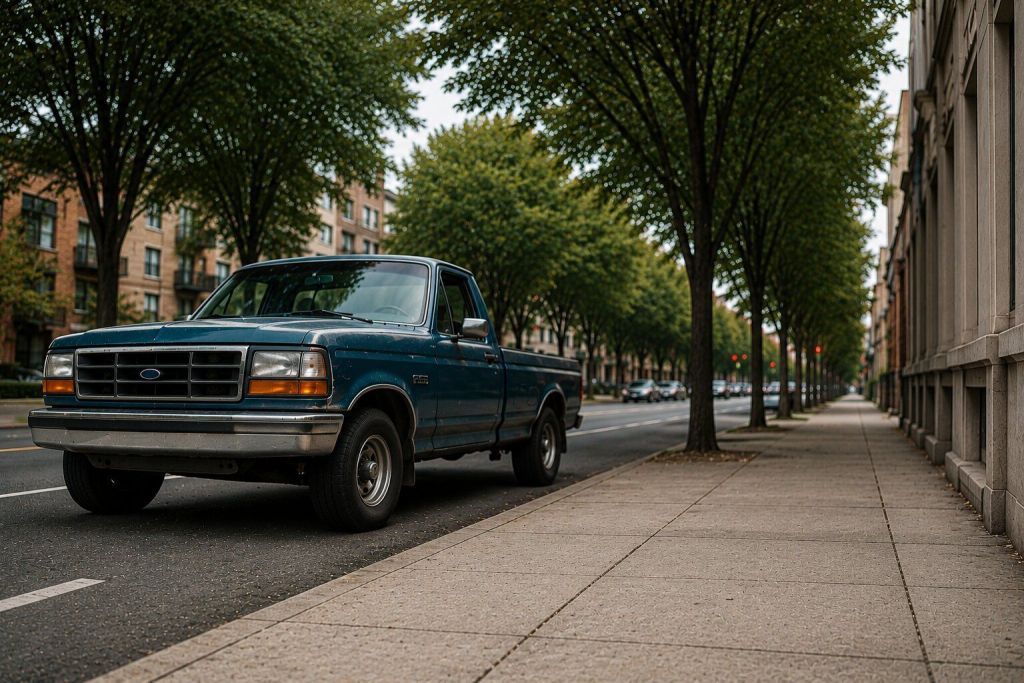
Imagine you are driving an older truck through busy streets when the pungent, unmistakable scent of gasoline fills the cabin. A fellow driver honks and points frantically at your vehicle. You look out the window to see a steady trail of fuel flowing behind the truck. In that split second, you realize you are driving a potential fireball. You do the only sensible thing: you pull over immediately to the nearest curb to assess the damage and call for help.
Most would call this a responsible emergency response. The City of Saskatoon, however, called it a parking violation.
His Majesty the King v. Reilly Brazeau 2026 SKKB 1 is a fascinating legal study in how common sense and longstanding legal principles can override the rigid application of municipal bylaws. It serves as an important precedent for anyone looking to dispute a parking ticket issued during an emergency.
A Guzzling Gas Tank and a $60 Ticket
On the day in question, Mr. Brazeau found himself in a mechanical nightmare. His truck was not just leaking; gas was guzzling out of the gas tank near the top of the fuel pump. Recognizing the imminent danger to himself and the public, Brazeau pulled into a pay station parking zone and immediately phoned his stepfather to arrange a tow.
The wait for help was approximately seven to eight minutes. Yet, in that narrow window of time, a parking commissionaire arrived. Despite the obvious mechanical distress of the vehicle, the commissionaire performed a computer check, determined no parking permit had been purchased, and issued a ticket.
While the fine was only $60, or $35 if paid early, the principle was the thing that caused Mr. Brazeau to forge ahead in his dispute. Mr. Brazeau challenged the ticket in Provincial Court. The Justice of the Peace who first heard the case expressed sympathy for Mr. Brazeau and granted an absolute discharge, meaning he was technically guilty but faced no fine.
Dissatisfied with this outcome, the City of Saskatoon appealed to the King’s Bench, arguing that the sentence was unfit and that a guilty verdict must carry the prescribed fine. Big mistake. Huge.
The Defence of Necessity
On appeal, the issue shifted from the amount of the fine to whether a crime had been committed at all. The Court raised a critical question: had the defence of necessity been fully explored?
The defence of necessity is a rare but powerful legal excuse. It is based on the concept of moral involuntariness. This means that while a person technically broke the law, they did so because they were under such extreme pressure from external circumstances that they effectively had no choice. As the sources note, society does not expect people to resist such pressure when life or health is at stake.
The Three-Part Test
To determine if Brazeau was truly involuntary in his actions, the court applied a rigorous three-part test derived from Supreme Court precedents like R v Perka and R v Latimer.
- 1. Imminent Peril or Danger
The first requirement is that the danger must be more than just likely; it must be on the verge of transpiring. In Brazeau’s case, the court found this element easily satisfied. The combination of a running engine’s heat and guzzling gasoline created a palpable danger of fire and explosion. The Court noted that the threat was an imminent danger to Brazeau and any others nearby.
- 2. No Reasonable Legal Alternative
For necessity to apply, the accused must have had no other viable, legal way to avoid the peril. The City of Saskatoon argued that once Brazeau had safely stopped the truck, nothing was stopping him from walking to a pay station and purchasing a parking permit.
The Court rejected this rigid interpretation. It clarified that Brazeau’s intention was never to park in the traditional sense; his sole purpose was to remove the danger. When a vehicle is a ticking time bomb, the law does not expect a driver to prioritize bylaw compliance over immediate safety and the arrangement of emergency services. Pulling over forthwith was the only sensible option.
- 3. Proportionality
The final pillar of the test is whether the harm inflicted by breaking the law is less than the harm avoided. This was perhaps the clearest point in the case. Brazeau breached a minor municipal parking bylaw—a victimless technicality—to avoid a potentially catastrophic explosion in a public area. The court ruled that the act of pulling over was completely proportional to the danger being presented.
Not Guilty
The appellate court therefore concluded that the lower court had indeed erred, but not in the way the City had hoped. The error was not in the sentence, but in the verdict itself. Because the defence of necessity was fully met by the facts of the gas leak, there should never have been a guilty verdict.
It set aside the guilty verdict and entered a verdict of not guilty.
A Significant Precedent
The Brazeau decision is a landmark for everyday drivers. Many traffic and parking tickets are strict liability offences, meaning the prosecution usually only has to prove you did the act (e.g., you parked without paying). The Brazeau case confirms that even in these cases, the defence of necessity remains a valid shield.
Importantly, while a defendant must provide enough evidence to raise the issue of necessity, they do not have to prove it beyond a reasonable doubt. Once the issue is raised, the Crown (or City) must prove that the act was voluntary and that no such emergency existed. The case is a judicial reminder to municipalities that the primary goal of traffic bylaws is public order, not revenue generation. When a bylaw conflicts with the immediate preservation of life and property, the courts will side with safety.
The fact that the City appealed an absolute discharge over a $60 ticket suggests a focus on technical compliance over the spirit of the law. The King’s Bench ruling acts as a check on this, ensuring that the legal system accounts for extraordinary circumstances. That is exactly why we have courts and indicative of their important role in the rule of law.
Conclusion
Mr. Brazeau’s victory is a win for common sense. It establishes that if you are forced to break a minor rule to prevent a major disaster, the law will excuse you. For those facing traffic tickets issued during mechanical failures, medical emergencies, or other perils, the Brazeau case provides the legal roadmap to ensure that justice, not just a bylaw, is served.
