Kyla Lee

Roadside Prohibitions for Saliva Drug Testing – A New Government Low

The biggest hint to date about what British Columbia’s drug-impaired driving scheme is going to look like is finally here. Solicitor General Mike Farnworth was quoted in The Province today as saying that a legislative scheme not unlike the Immediate Roadside Prohibition scheme might soon become a reality.

It’s nice to know he’s creating a new prohibition scheme when the one that he criticized while in opposition remains unrepaired.

But what the article in The Province hints at is that roadside testing will be done by way of saliva testing. And this is inherently problematic.

Roadside Prohibitions for Saliva Drug Testing – A New Government Low Read More »

29 Year Old Veteran Investigator: Now, The Accused

Cst. Jim Fisher makes an appearance in court for allegations including sexual assault charges.

The ex-VPD detective was facing a host of charges against him including a number of sexual assault counts which have now been dropped.

The 29-year veteran investigator instead pleaded guilty to three charges: two separate counts of breach of trust and one of committing sexual exploitation.

29 Year Old Veteran Investigator: Now, The Accused Read More »

Radio NL Kamloops: Kyla Lee is raising the alarm over federal justice reforms

A lawyer with Acumen Law is raising the alarm over the Trudeau government’s so called bold criminal justice reforms.
Kyla Lee says Bill C-75’s faults have been getting a lot of media attention but she says one concerning aspect has been overlooked..

Lee says the bill limits cross examination of police officers over what it calls routine police evidence, which might not sound nefarious.

“But the definition in the bill of routine police evidence is actually very significant. It encompasses everything a police officer does from identifying an accused individual to anything they say with them or otherwise interacting with them. It covers the collection, handling, and identification of evidence as well as making observations. That is everything that policing is.”

Radio NL Kamloops: Kyla Lee is raising the alarm over federal justice reforms Read More »

The Government’s Drug-Impaired Driving Scheme May Ruin The Rest of Your Life – And I’m Not Joking

Picture

(CBC Photo)

This weekend, an opinion piece in CBC got me thinking: what happens to Canadians who want to seek entry into the United States but are marijuana users, after marijuana is legal?

The Government has not anticipated the host of problems that legalization will pose for cross-border travellers. And while use of marijuana is a ground to exclude entry into the United States, my greater concern is how driving-related marijuana offences recorded on the driving record will impact those seeking entry into the United States.

Currently, every province is considering how it will address the problem of drug-impaired driving once legalization is complete. In British Columbia, the Government has hinted at the likelihood of a further roadside prohibition scheme to address the so-called problem of drug-impaired driving. Leaving aside the fact that drug-impaired driving is both already an issue and already addressed in legislation, making all of this really a non-issue, an expanded roadside prohibition scheme will have devastating consequences of the type the alcohol-impaired schemes do not.

The Government’s Drug-Impaired Driving Scheme May Ruin The Rest of Your Life – And I’m Not Joking Read More »

Joint Sentencing Submissions and the Case of Former Detective Constable Fisher

Picture

Detective Constable Jim Fisher. (CTV. March 28, 2018)

Last week, disgraced former Vancouver Police Department Detective Constable Jim Fisher pleaded guilty to three charges of abuse of trust and sexual exploitation of a minor. He had been facing a slew of charges, which had slowly been whittled away by the Crown and ultimately pleas were entered on three of them. Each of the three charges refers to his interactions with minors who were also witnesses in cases that he was managing.

The Court ordered a pre-sentence report, and the matter was adjourned for that to occur and for the submissions of counsel. Prior to the pleas being formally entered, the court was asked to canvass certain provisions of the Criminal Code with Fisher. The judge seized of the matter warned him that he would not be bound by the position of Crown and defence.

With this in mind, the case raises very interesting issues relating to the law of joint submissions.

In Canadian criminal law, a longstanding tradition has been that agreements between the Crown and Defence are to be followed by judges, unless there is good reason to depart from the joint position. However, until recently there was no hard and fast rule about this. In late 2016, the Supreme Court of Canada released its decision in R. v. Anthony-Cook, a decision addressing joint submissions. The Court ruled that judges should not depart from a joint submission unless the administration of justice would be brought into disrepute or the proposed sentence would be contrary to the public interest.

Joint Sentencing Submissions and the Case of Former Detective Constable Fisher Read More »

Omnibus Bill C-75 Does More Bad Than Good

In a deliberately-timed move, the Liberal Government has introduced yet another phase of its absurd legislation, aimed at chipping away what fundamental principles of justice remained intact after Bills C-45, C-46, and C-51. Bill C-75, introduced on Thursday, is an omnibus bill that is comprised of numerous sweeping and devastating changes to the justice system.

Oh, sure, there are some nice things in the Bill. There is the ability restored to judges to use discretion in imposing a victim fine surcharge. And there are additional provisions to allow for judges to consider Indigenous ancestry or marginalization for other reasons in sentencing accused individuals. There are provisions that allow for easier changes to bail or probation conditions where they are not manageable for an individual. Well, those changes are fraught with problems best suited for another blog post.

The purpose of the Bill, as touted by Jody Wilson-Raybould, is to address issues that contribute to delay in our justice system and to provide needed assistance to the most vulnerable people in our population.

For the reasons I outline in this blog post, the Bill fails in those goals.

Omnibus Bill C-75 Does More Bad Than Good Read More »

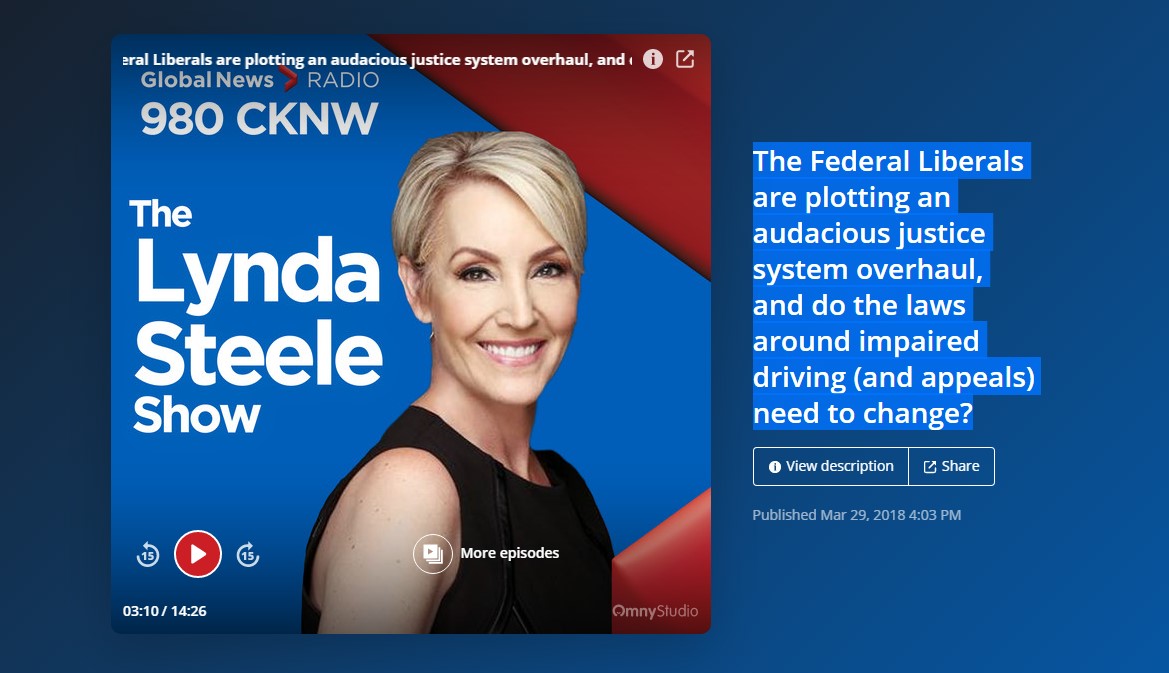
Kyla Lee interviewed on CKNW: The Federal Liberals are plotting an audacious justice system overhaul, and do the laws around impaired driving (and appeals) need to change?

The Liberal government has introduced legislation to overhaul the criminal justice system.  If passed, this bill would eliminate the use of peremptory challenges, which allow lawyers to reject jury candidates during selection.  The bill includes other measures aimed at tackling court backlogs plaguing the criminal justice system, including by restricting the use of preliminary inquiries.

The bill will also address a Liberal campaign promise to crack down on intimate partner violence, including by reversing the onus on bail for those previously convicted of violence against a current or former spouse, common-law partner or dating partner.

Kyla Lee interviewed on CKNW: The Federal Liberals are plotting an audacious justice system overhaul, and do the laws around impaired driving (and appeals) need to change? Read More »

Breaking Down Police Testimony by Affidavit

When the Federal Liberal Government introduced Bill C-75 with much fanfare on March 29, 2018, it is doubtful they expected the backlash they received from the legal community and the public at large. The Bill proposes sweeping and significant changes to the criminal justice system, but fails to incorporate promises apparently long-since-forgotten from the campaign trail. There is no reform of mandatory minimum sentences. There is little respect for the Charter or due process.

Stories quickly emerged in every major and minor media outlet, criticizing the Bill for its elimination of preliminary inquiries, reversal of the onus provisions in certain bail hearings, and removal of peremptory challenges in jury selection. Unfortunately, the news media’s focus on these three significant (and by no means unimportant) changes diverted attention away from some of the much more insidious aspects of Bill C-75.

Late in the evening that day, I sat down to take a stab at understanding this omnibus monstrosity. I penned a, perhaps sarcastic, 2400 word piece criticizing the major changes and some more minor ones. But even in 2400 words I could not break down the issues well enough.

So I’m going now to attempt to explain why, in my opinion, the changes in relation to affidavit evidence from police in criminal cases is one of the most deserving of attention and deserving of criticism.

Breaking Down Police Testimony by Affidavit Read More »

Kyla Lee on Roundhouse Radio: Bill C-46 opens the government up for a constitutional challenge

As the government prepares for its cannabis legislation to be passed, Bill C-46 — the government’s new impaired driving bill — will institute a whole new framework for marijuana impaired driving and revamp existing frameworks for alcohol impaired driving by adding random breath tests, salvia tests, and even, blood tests.

Acumen Law Corporation lawyer Kyla Lee talks to Stirling Fox on Roundhouse Radio about Bill C-46 and why the bill opens the government up to constitutional challenge.

Kyla Lee on Roundhouse Radio: Bill C-46 opens the government up for a constitutional challenge Read More »

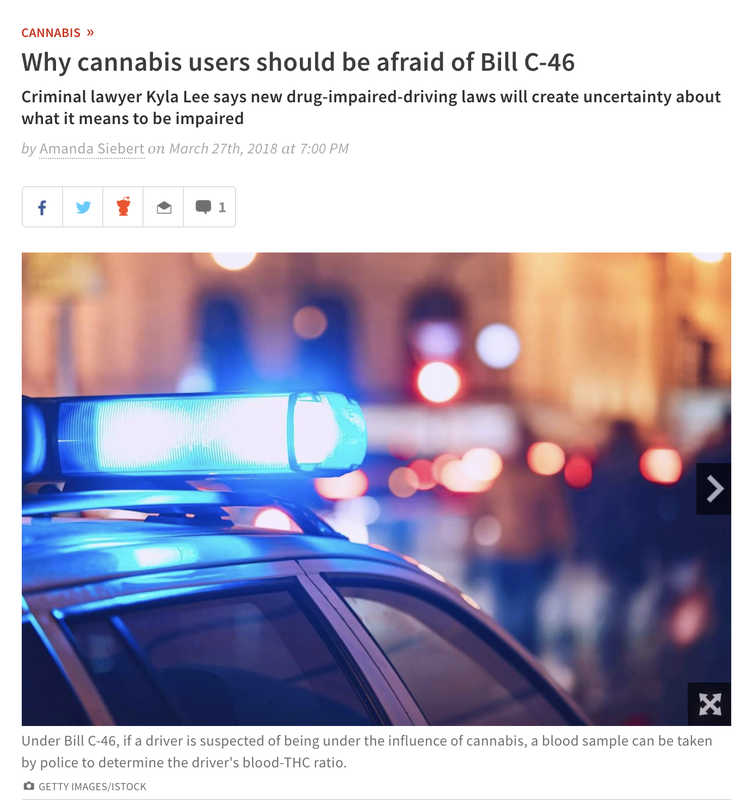
Amanda Siebert: Why cannabis users should be afraid of Bill C-46

A few weeks ago, I tweeted something that would, unwittingly, ruffle a few feathers.

“Someone needs to tell the guy ashing a joint out of his sports car sun roof that his days are numbered,” I wrote. “Wonder if he’s heard of C-46?”

I’ll be straight up: It was deleted out of sheer embarrassment after a few people pointed out that it came across as a moral assessment of the driver’s choice to smoke a joint while at the wheel.

While my intention—to point out that cops across the country are preparing for an all-out roadside offensive against drivers like the one I saw—was poorly conveyed, a follower noted that instead of making it sound like the driver deserved what was coming to him, I ought to “use my platform as a journalist” to discuss the bill’s flaws.

Amanda Siebert: Why cannabis users should be afraid of Bill C-46 Read More »

Scroll to Top
CALL ME NOW