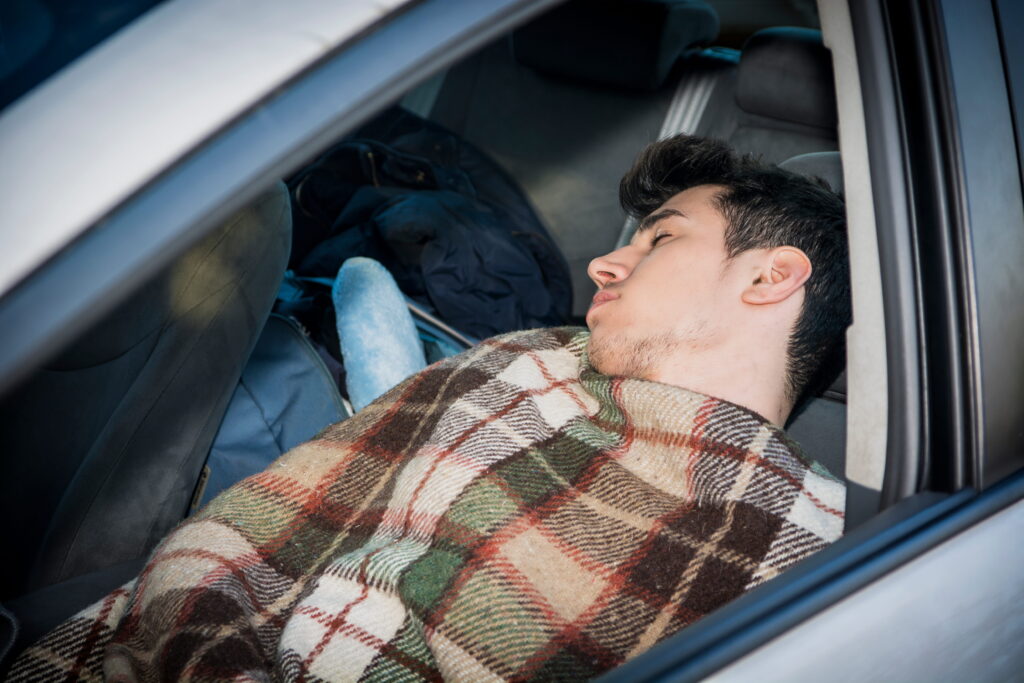
Many people think sleeping in their vehicle is a safe alternative to driving home after a night out. But in reality it is actually one of the most common ways people end up with a criminal record.
We have all heard the advice that if you have had too much to drink, you should just sleep it off in your car. However, the case of His Majesty the King v. Michael Alan Loney is a perfect example of why that plan can go sideways very quickly.
If you are sitting in the driver’s seat with the engine running, even if you are fast asleep and have no intention of moving an inch, the law in Canada views you very differently than you might expect.
Let’s look at what happened to Mr. Loney.
In the early morning hours, a police officer found him asleep behind the wheel of his running pickup truck in a parking lot. He was so deeply asleep that the officer had to open the door and tap him on the shoulder multiple times to wake him.
When he finally came to, it was clear he was in no condition to be driving. Breath tests later showed a blood alcohol level of 270 mg%, nearly three and a half times the legal limit. He was so intoxicated that he had lost control of his bladder and was unable to walk to the police cruiser without help.
Now, you might think that since he was parked nose-in against a fence and clearly asleep, he wasn’t driving. But this is where the legal concept of care and control comes into play.
Under the Criminal Code, there is something called the presumption of operation. This means that if the police find you in the seat normally occupied by a driver, the law automatically assumes you are there for the purpose of setting the vehicle in motion. It doesn’t matter if you are dreaming; the burden shifts to you to prove, on a balance of probabilities, that you didn’t actually intend to drive.
Mr. Loney tried to fight the charge by explaining his mental risk management assessment.
His original plan to stay with a friend had fallen through at the last minute. He argued that he chose to sleep in his truck because it was the safest, least disruptive option. The only door his key worked in was the driver’s side, which is why he entered there. To get some heat on a chilly spring night, he turned the engine on for a few minutes. He even mentioned he had a sleeping bag and had taken off his glasses to show he was settled in for the night.
The judge, however, found several problems with this story. First, there was a major issue with credibility. Mr. Loney testified that he was 12 out of 10 drunk and couldn’t even control his own bodily functions, yet he claimed he was able to perform a detailed and nuanced assessment of his options before getting into the truck. The judge didn’t buy the idea that someone so profoundly intoxicated could logically weigh the pros and cons of taking a taxi versus sleeping in a running truck. There were also inconsistencies in his story, such as his claim that he was reclined in the seat, while the officer found him slumped forward over the steering wheel.
Even if the judge had believed that Mr. Loney truly didn’t intend to drive, there is a second hurdle called the realistic risk of danger.
The Supreme Court has ruled that even without a contemporaneous intention to drive, you can still be guilty of care and control if your presence in the vehicle creates a risk to the public. This risk can happen in three ways: you might change your mind while you’re still drunk and decide to drive after all, you might accidentally put the vehicle in gear while you’re tossing and turning, or the vehicle itself might become a hazard because of how it’s positioned.
In Mr. Loney’s case, the judge noted that the parking lot was fairly full and situated near a cluster of bars. This meant there were likely other people and cars moving around. Being passed out behind the wheel of a running engine while three times over the limit created a tangible risk that surpassed a mere theoretical possibility. The court pointed out that impaired judgment is a hallmark of being drunk, and someone in that state is in no position to accurately judge when they are sober enough to eventually drive home.
Ultimately, Mr. Loney was found guilty.
The judge concluded that he failed to rebut the legal presumption that he intended to drive, and even if he had, his state of extreme intoxication in a running vehicle posed a realistic risk of danger to the community.
So, if you are ever out and find yourself in a similar spot, the best advice I can give you as someone who wants to keep you out of a courtroom is this: stay out of the driver’s seat.
If you absolutely must sleep in your vehicle, do not put the keys in the ignition and, if possible, stay in the back seat. The law treats a running car as a potential weapon, and the sleeping it off defence is much harder to prove than most people realize.
