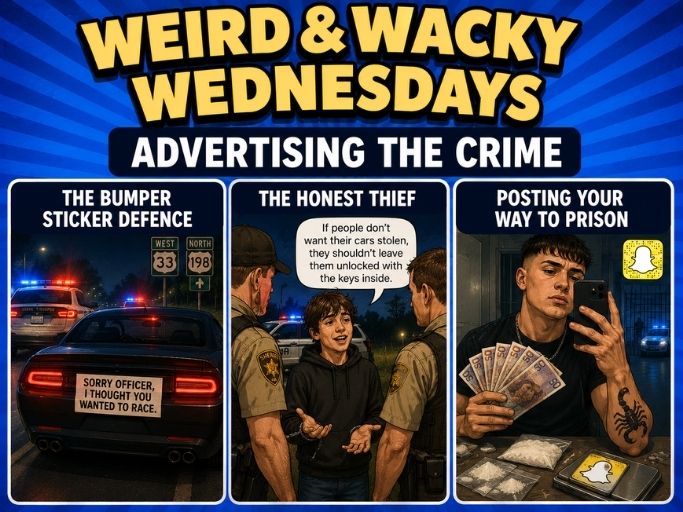
This week on Weird and Wacky Wednesdays: Advertising the Crime
Some defendants make the prosecutor’s job almost too easy. They post the evidence. They wear the evidence. They drive around with the evidence stuck to the back of the car. Every so often they go further and explain the whole thing directly to the officer at the side of the road. This week’s stories come from Buffalo, suburban Kansas City, and a small town in Wales. They do not have much in common except for one detail. In each of these cases, the defendant made an unforced contribution to the file.
I tell people all the time that the right to remain silent exists for a reason. It is not just something they say on American police shows. It is a real Canadian constitutional protection, and the smarter end of my client list takes it seriously. The people in this week’s stories did not get the memo.
The Bumper Sticker Defence
On the morning of April 4, 2026, New York State Troopers out of SP Clarence were running a joint speed enforcement detail with the Buffalo Police along Route 33. They noticed a 2015 Dodge Challenger going much faster than it should have been. The car also happened to have no licence plates. As the troopers pulled in behind it, they spotted something else worth their attention. On the back of the Challenger was a bumper sticker that read “Sorry Officer, I Thought You Wanted to Race.“
What happened next was about as predictable as anything could be. The driver, a 23 year old man named Elias Cook, did not pull over. He fled. The chase was very short, because the Challenger exited onto Route 198 and ran straight into traffic congestion. The troopers boxed him in and Cook was arrested without further incident.
He was charged with unlawful fleeing a police officer in the third degree and aggravated unlicensed operation of a motor vehicle in the third degree. The sticker did not make it into the criminal complaint, but it is hard to imagine a more accurate roadside confession. If you are going to install a slogan on the back of your car that essentially predicts your own driving behaviour, you might want to consider not also driving without plates. Or you could just not buy the sticker. Either option works.
The Honest Thief
A week and a half later, on April 15, 2026, Clay County Sheriff’s deputies in northeast Kansas City picked up a 13 year old who had been driving a stolen car around Missouri Highway 210 at one in the morning. The arrest itself was not especially interesting. The car had been reported stolen, deputies caught up with it after a curb strike took out a tire near North Kansas City Hospital, the teen tried to flee on foot through a field near North Bellefontaine Avenue, and that was the end of it. Two adults in their early twenties, Kayden Nolen and Kevante White, were also picked up and charged with resisting arrest and tampering with a motor vehicle.
The interesting part came after the cuffs went on. The 13 year old, by way of explanation, told the deputies that if people did not want their cars stolen, they should not leave them unlocked with the keys inside.
This is the rare statement that manages to combine a confession, a policy argument, and a side helping of victim blaming into a single sentence. I have heard a lot of things from clients over the years. I do not recall anyone ever laying out the entire theory of their case to the arresting officer while still standing in the field they were caught in. The juvenile justice system in Missouri will sort him out, but somewhere down the line a future defence lawyer is going to inherit this file and gently explain that the right to remain silent really does mean what it says.
Posting Your Way to Prison
The third story comes from across the Atlantic. Tristan Wilson, 19, of Ebbw Vale in south Wales, was jailed earlier this year after Snapchat caught up with him. Wilson had developed a habit of posing for photographs with bundles of cash and what appeared to be a generous personal supply of cocaine. He then posted those photographs to Snapchat, presumably for the admiration of his audience.
Wilson made one tactical decision that compounded all the other tactical decisions. He had a distinctive scorpion tattoo on his arm, and it was clearly visible in the photos. Gwent Police were able to compare the tattoo in the Snapchat shots to the tattoo on a young man already on their radar. From there, the case got short. Wilson was unable to offer any innocent explanation for why his Snapchat looked like a still from a drug dealer training video, and he ended up pleading guilty and being sent to prison in January 2026.
There are a few lessons in this one. The first is that Snapchat is not as ephemeral as the marketing suggests. Police forces are very comfortable preserving social media content for later use, and so are the friends and acquaintances who screenshot it long before the police ever ask. The second is that if you are going to commit a crime, distinctive body art is generally not an asset. The third is the same as the lesson in the other two stories. If you put the offence in writing, on the bumper, on Snapchat, or out loud to the deputy who is still pulling you out of the field, the prosecution does not have to work very hard.
We will see you next Wednesday for more weird and wacky legal stories.
