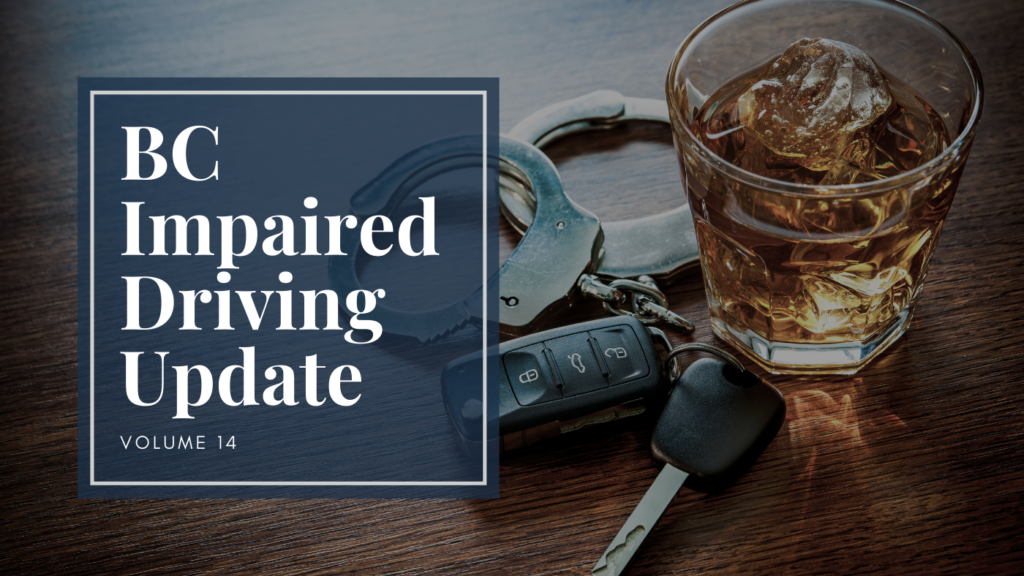
Welcome to British Columbia’s only weekly DUI law update newsletter. This newsletter contains the most cutting-edge information, the newest case law, and helpful practice tips for DUI defence in BC.
Authored by Kyla Lee, BC’s Impaired Driving Update is released weekly on Thursdays.
What’s inside:
- Impaired Driving Defence Tip
- IRP Decision of the Week
- DUI Decision of the Week
- Kyla’s Insight
1. Impaired Driving Defence Tip
Make the tough argument.
Sometimes being a lawyer is really uncomfortable. You may be thrust into a position where you have to call out the behaviour of Crown counsel or the judge. You have to be prepared to advocate for your client and make the tough argument or put the judge or Crown, or both, in an uncomfortable position to address your submissions. Many will get their backs up and become defensive or try to turn it around on you. Stand your ground. Trust your instincts and know that when you feel something is wrong, it probably is.
At the end of the day, your duty to your client outweighs any relationship you may be worried about damaging in the courtroom.
2. IRP Decision of the Week
Prohibition Revoked:
Police received a call earlier in the night about a vehicle that had trouble parking. The driver exited the vehicle and stumbled into a nearby restaurant. Police kept an eye on the vehicle and several hours later observed it pulling out of the parking stall. A traffic stop was conducted.
The detaining officer detected indicia of impairment and smelled an odour of liquor on the driver’s breath. The detaining officer requested another officer attend with an ASD. That officer arrived, formed his own suspicion that there was alcohol in the body of the driver, and read an ASD demand.
The driver attempted to provide a sample into an approved screening device but was unsuccessful.
The applicant provided evidence, supported by witnesses, that he had consumed a lot of food that night. He had a full stomach that was pushing on his diaphragm. In addition, he provided medical evidence to the effect that he had a diagnosed asthma condition that was aggravated by environmental factors at the time of testing. He indicated that he was making a genuine effort to blow but was unable to do so due to either or both of the issues affecting his breathing.
Kyla Lee successfully argued that the applicant did not fail or refuse to comply with the demand for samples. The applicant had a medical issue exacerbated by environmental factors and contributed to by the full stomach impacting his ability to successfully blow. In addition, the police evidence related to the efforts to provide a sample was internally inconsistent and unreliable as the officer claimed there were certain status messages on the device that did not correspond to the alleged behaviour.
The prohibition was revoked.
3. DUI Decision of the Week
In Berube v. R 2026 NBCA 19, the question of the operative start date of driving prohibitions came before the court. Specifically, the question centred around the date on which a driving prohibition starts when a person is sentenced for a driving related offence along with other offences at the same time.
Mr. Berube was sentenced to a total aggregate term of 4.5 years, which included one year for dangerous driving and 3.5 years for aggravated assault and failing to appear. The trial judge imposed a three year driving prohibition. The Court of Appeal had to determine whether the Criminal Code requirement that a prohibition include “the entire period to which the offender is sentenced to imprisonment” referred to Berube’s total 4.5 year term or only the prison term for the driving offence.
The Court concluded that the prohibition period is structurally and textually tethered only to the specific sentence imposed for the driving offence. The authority to issue such a prohibition under Section 320.24 is granted in addition to any other punishment that may be imposed for that offence, meaning the calculation of the prohibition must be linked specifically to the custodial sentence for that same crime. This interpretation was further supported by the French text of the provision.
A central reason for this decision was the need to avoid arbitrary outcomes caused by procedural happenstance. If the aggregate sentence were used, the length of an offender’s driving prohibition would depend on whether unrelated charges were sentenced on the same day or different dates. Not only would this treat different offenders differently for the same conduct, but it would also frustrate the system in that it would discourage combined sentencings. The Court held that including non designated offences would result in an enhanced punishment for crimes that do not legally justify or permit a driving prohibition. By limiting the calculation to the driving related sentence, the law remains coherent and ensures that the penal consequence remains proportional to the specific dangerous driving conduct.
4. Kyla’s Insight
Be careful about how you use this decision. The NBCA is at odds with the NSCA in R. v. Arseneault 2024 NSCA 10, which came to the opposite conclusion. Arseneault states that where an offender is sentenced to a cumulative term of imprisonment including for non driving offences, the driving prohibition only begins to run when the offender is actually released from prison for all offences.
The reasoning in Arseneault is that Parliament could not have intended for a driving prohibition to run while an offender was already behind bars, as the loss of driving privileges would have no consequence during that period. An attractive argument to be sure. But if your Crown tries to argue Arseneault you can point to the fact that the NBCA cannot legislate differently than Parliament’s intention and had they intended it to start from the date of release for all offences, they would have said so. You can ground this in the very strict textual interpretation of driving prohibition provisions given in the SCC decision in R. v. Wolfe.
And, if you have a client who is facing a lengthy jail term for a number offences plus a driving prohibition, it may be worthwhile to throw in the driving offences into the sentencing if there’s a chance all or some of the prohibition will run while they are in custody.
5. Resources
Want to know more about impaired driving and Immediate Roadside Prohibitions in BC? Here are some helpful resources:
The BC Motor Vehicle Act: https://www.bclaws.gov.bc.ca/civix/document/id/complete/statreg/96318_00
Criminal Code Offences Relating to Conveyances: https://laws-lois.justice.gc.ca/eng/acts/c-46/page-46.html#h-121277
CanLII: https://www.canlii.org/
RoadSafetyBC: https://www2.gov.bc.ca/gov/content/transportation/driving-and-cycling/roadsafetybc
6. Contact Us
The police have their experts. You should have yours.
Charged with impaired driving? Get the lawyer who literally wrote the book on it. Call Kyla Lee at Acumen Law today. Visit our contact form or call 604-685-8889 or email kyla@vancouvercriminallaw.com
7. Featured Firm
Featured Firm: Acumen Law Corporation
Based in Vancouver, Acumen Law Corporation is one of British Columbia’s leading criminal defence firms, recognized across Canada for its work in impaired driving law. The firm’s lawyers have successfully defended thousands of Immediate Roadside Prohibitions, criminal impaired charges, and driving suspensions.
Kyla Lee, a partner at Acumen Law, is widely regarded as a national authority on DUI law. She has authored multiple legal textbooks, teaches DUI defence across North America, and regularly appears in the media explaining developments in driving law.
Acumen Law is known for its deep understanding of both the law and the science behind impaired driving cases. The team approaches every file with meticulous preparation and a commitment to protecting the rights of drivers across BC.
