Blog

Defamation: Cases That Should Have Gone to the Supreme Court of Canada, But Didn’t!

Welcome to “Cases That Should Have Gone to the Supreme Court of Canada, But Didn’t!”

In this episode, Kyla Lee from Acumen Law Corporation examines a case involving a defamation lawsuit between a home building company and dissatisfied homeowners. After the homeowners posted negative reviews online, the company sued for defamation. The homeowners responded by seeking to have the case dismissed under British Columbia’s anti-SLAPP legislation, arguing that their posts constituted expression on a matter of public interest. The Supreme Court of Canada declined to hear the case, leaving open significant questions about how far anti-SLAPP protections extend in private disputes.

Defamation: Cases That Should Have Gone to the Supreme Court of Canada, But Didn’t! Read More »

Weird and Wacky Wednesdays: Volume 379

This week on Weird and Wacky Wednesdays: The market for human body parts

This could have been a topic I covered for Halloween, but a particularly strange legal story appeared just last week in the news. And so here we are, at Christmas, discussing the market for human body parts. Of course, not everybody celebrates Christmas as warm, bright, or celebratory. Some people are tired, and some people are grieving. This week I’m doing something slightly counterintuitive and talking about death and things in packages despite it being Christmas. 

Birth and death are not strange. They are the most banal human experiences because this happens to every one of us. What is unusual is to die and have your body parts become inventory, a good to be traded. This week on Weird and Wacky Wednesdays, we’re going to look at three recent and connected cases where the law had to step in because people were selling body parts. 

Weird and Wacky Wednesdays: Volume 379 Read More »

Can Police Swap Legal Justifications For Demands After the Fact? 

Every so often a judgment comes along that quietly rewrites the rules while pretending nothing has changed. R. v. Jerlo is one of those decisions. On its face, it looks like a simple impaired-driving case involving a self-represented accused and a helpful amicus. 

Underneath, it signals a quiet but substantial erosion in search-and-seizure protections, effectively giving police permission to retrofit their legal justification for a roadside breath demand after the fact. And because the accused was self-represented, the only pushback came through an amicus whose mandate stopped well short of mounting the vigorous constitutional challenge this issue deserved.

Can Police Swap Legal Justifications For Demands After the Fact?  Read More »

Obstruction of a Police Officer: Cases That Should Have Gone to the Supreme Court of Canada, But Didn’t!

Welcome to “Cases That Should Have Gone to the Supreme Court of Canada, But Didn’t!”

In this episode, Kyla Lee from Acumen Law Corporation examines a case involving an arrest for obstruction in the context of a routine traffic enforcement encounter. A person who was pulled over for a regulatory traffic matter—such as speeding or running a red light—was arrested for obstruction when they attempted to leave. Although the trial judge found the arrest unlawful, the Court of Appeal reversed that decision. The Supreme Court of Canada declined to hear the case, leaving unresolved questions about the scope of police powers in regulatory versus criminal contexts.

Obstruction of a Police Officer: Cases That Should Have Gone to the Supreme Court of Canada, But Didn’t! Read More »
Episode 433: Traffic Court Delay, Disclosure Traps, and Overpass Strikes + Bonus Christmas Song

In this episode of Driving Law, Kyla Lee and Paul Doroshenko break down a troubling new BC Supreme Court decision that reshapes how delay and disclosure are treated in traffic court. They explain why the ruling creates serious traps for self represented drivers and why it misunderstands how traffic court actually works in practice.

Episode 433: Traffic Court Delay, Disclosure Traps, and Overpass Strikes + Bonus Christmas Song Read More »

Weird and Wacky Wednesdays: Volume 378

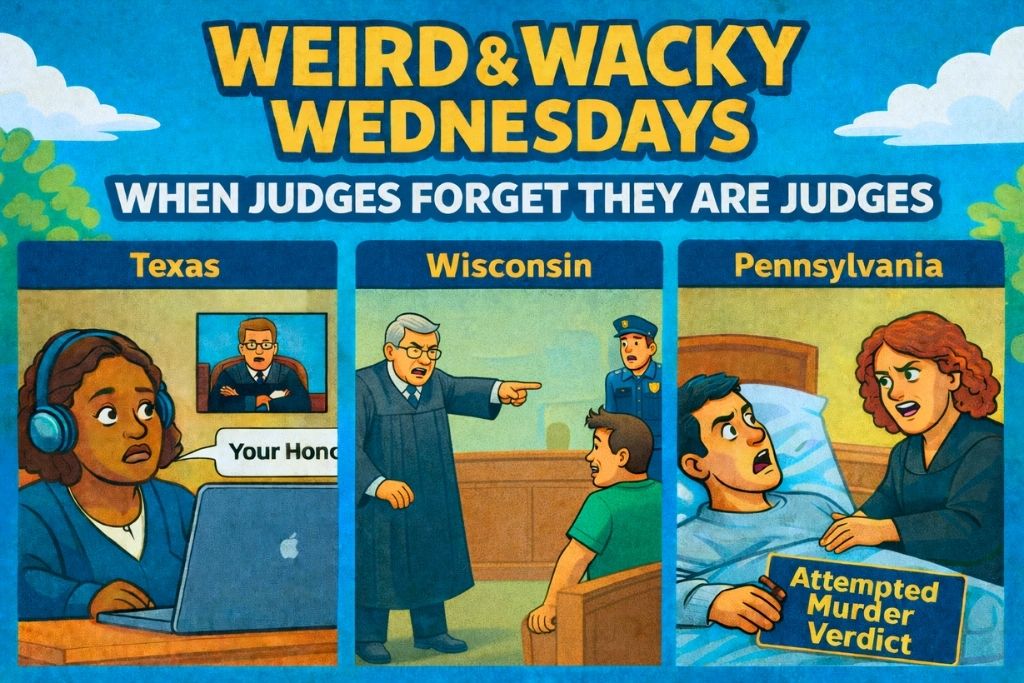
This week on Weird and Wacky Wednesdays: When Judges Forget They Are Judges

Judges hold enormous power. They control courtrooms, decide liberty, and are trusted to follow rules even when no one is watching. Most do. Some forget where the line is. This week’s stories share a common theme: judges who appeared to forget that wearing a robe does not turn you into a dispatcher, a police officer, or someone above the criminal law.

Weird and Wacky Wednesdays: Volume 378 Read More »

Why You Need a Lawyer to Help Avoid Points and Unintended License Consequences

Police vehicle pulling over a white SUV for speeding on a city road in British Columbia

You might think fighting a traffic ticket is straightforward. Pay the fine, accept the points, and move on. But what happens when that simple decision threatens your entire livelihood? The recent case of R. v. Chen, 2025 BCSC 2350 offers a stark reminder that even minor convictions can have major, unforeseen consequences, especially when you navigate the legal system without expert advice.

This case revolved around Mr. You-Yu Chen, a full-time ride-share (Uber) driver in British Columbia.

Why You Need a Lawyer to Help Avoid Points and Unintended License Consequences Read More »

Airbnb Bans: Cases That Should Have Gone to the Supreme Court of Canada, But Didn’t!

Welcome to “Cases That Should Have Gone to the Supreme Court of Canada, But Didn’t!”

In this episode, Kyla Lee from Acumen Law Corporation explores a case challenging a provincial Airbnb ban. The applicant, who operated multiple short-term rentals, argued that the new licensing regime violated his Charter rights—specifically, his right to equality under section 15. While the courts rejected the claim and the Supreme Court of Canada declined to hear the case, it raised important questions about the intersection of economic participation, immutable characteristics, and evolving forms of work in the gig economy.

Airbnb Bans: Cases That Should Have Gone to the Supreme Court of Canada, But Didn’t! Read More »
Episode 432: Bill C-16, Court Delays, and a CVS Officer Crash

This week on Driving Law, Kyla and Paul examine Bill C-16, a sweeping federal criminal law bill that quietly rewrites court delay rules, evidence retention timelines, and sentencing discretion — with serious consequences for impaired driving cases.

Episode 432: Bill C-16, Court Delays, and a CVS Officer Crash Read More »

Scroll to Top
CALL ME NOW