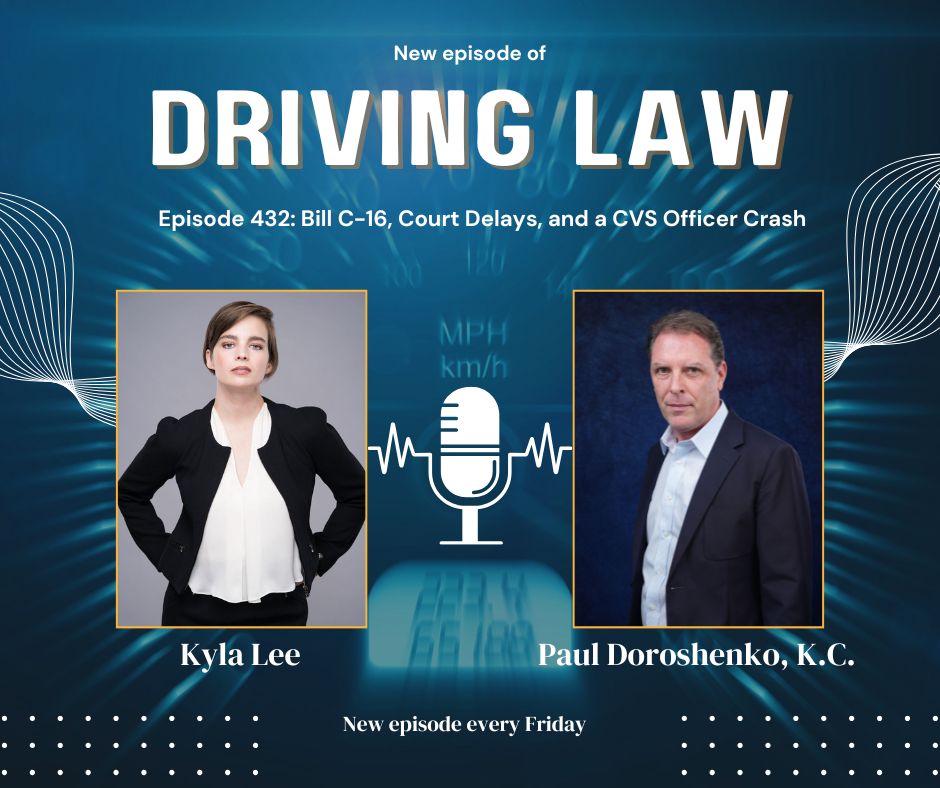
This week on Driving Law, Kyla and Paul examine Bill C-16, a sweeping federal criminal law bill that quietly rewrites court delay rules, evidence retention timelines, and sentencing discretion — with serious consequences for impaired driving cases.
Bill C-16 is framed as a response to court backlogs and unconstitutional mandatory minimums, but its real impact is felt by accused persons navigating an already underfunded justice system. The bill restricts judges’ ability to stay proceedings for unreasonable delay and redefines what counts as a “complex case,” forcing accused individuals to choose between bringing Charter applications or preserving their right to be tried within a reasonable time.
For impaired driving cases, the changes are especially significant. Charter voir dires, disclosure battles, and evidentiary challenges are routine — and under Bill C-16, those necessary defence steps would now be treated as delay the accused must “eat.” The bill also doubles the time police may retain seized items, including blood and urine samples, despite ongoing concerns about lab backlogs, transparency, and reliability.
The episode also explores Parliament’s attempt to introduce a limited sentencing “safety valve” while explicitly excluding impaired driving offences, reinforcing the uniquely punitive approach taken toward these cases. In the Ridiculous Driver of the Week, the hosts close with a surreal story of a CVS enforcement officer crashing into the same B.C. backyard that has already seen three similar incidents in recent years.
Stream Episode 432 for the full discussion.
