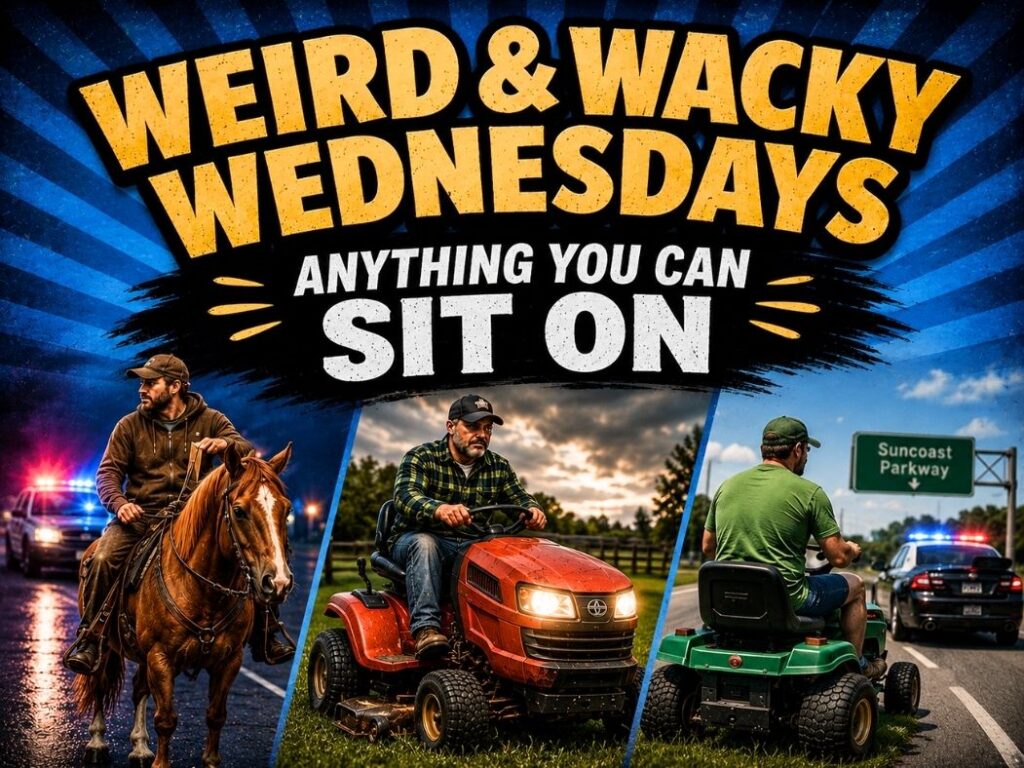
This week on Weird and Wacky Wednesdays: Anything You Can Sit On
People assume a DUI requires a car. A real car, with four wheels, a steering wheel, and a stereo loud enough to annoy the neighbours. After years of working on impaired driving files, I can tell you the law has a much bigger imagination than that. The word that does the heavy lifting is not “car.” It is “operate.” And once you understand how broadly that word gets read, you start to look at the lawn equipment in your shed a little differently.
The stories this week are all variations on one theme. Each one features a person who got behind the controls of something that was never meant to leave the driveway, or the pasture, and discovered that the police did not find the choice of vehicle nearly as funny as the internet did. The machines keep getting stranger. The charges keep getting laid anyway.
A Horse Walks Onto a Sidewalk
We may as well start with the one that has no motor at all.
In March, an officer in Bowling Green, Kentucky, was driving along Glen Lily Road when he spotted a man slumped over on a horse. According to the citation, the rider then steered the horse onto the sidewalk, which is not where horses generally belong. Police reported a strong odour of alcohol, bloodshot eyes, slurred speech, and delayed movement, and the man was arrested and charged with operating a non-motor vehicle under the influence.
Here is the detail that elevates the whole thing. He told police he had just left a liquor store and was headed home, and there was a liquor store bag tied to the saddle to back up his story. I want to be fair to the man. He had a designated driver. The designated driver simply had four legs, no licence, and no particular opinion about the sidewalk. Kentucky, it turns out, has a specific offence for exactly this situation, which tells you it has come up before.
The Caledon Lawn Tractor
Closer to home, the machines get an engine but not much more dignity.
In early April, Caledon OPP conducted an impaired driving investigation involving a lawn tractor, and a 57 year old man ended up facing charges. The reporting is brief, which is its own kind of poetry. There is no chase, no dramatic standoff, just a lawn tractor, an evening, and an investigation that did not go the way the operator hoped.
I include this one because people are always surprised that it is a Canadian story. They assume the riding mower DUI is an exclusively American art form. It is not. In this country a lawn tractor is perfectly capable of earning you a criminal record, and I will explain why a little further down.
Rush Hour on a Riding Mower
If Caledon was quiet, Florida decided to do the loud version.
Last summer, troopers in Florida received calls about a man operating a riding lawn mower on the southbound side of the Suncoast Parkway, which is a toll highway and not, by any reasonable measure, a lawn. Traffic cameras tracked the mower as it travelled from one county into the next before troopers stopped the rider. He showed several signs of impairment, declined to perform the field sobriety exercises, and was arrested on a DUI charge. He was released later that day on a $500 bond.
There is a practical lesson buried in this one, the same lesson I give clients all the time. The problem is rarely the destination. The problem is the part where you are visible, slow, and travelling in a straight line down a road full of people with phones. A riding mower on a toll highway is the single most reportable thing a human being can do before lunch. He was, in effect, his own tip line.
What Actually Counts in Canada
This is the part where the DUI lawyer in me cannot help herself, because the law underneath these stories is genuinely interesting.
The Criminal Code does not make it an offence to impaired-drive a “car.” It makes it an offence to operate a “conveyance” while impaired, and conveyance is defined to include motor vehicles, vessels, aircraft, and railway equipment. The definition of “motor vehicle” is broader still. It captures anything propelled by a means other than muscular power. That is why a golf cart, an ATV, a snowmobile, and yes, a riding lawn mower can all land you in front of a judge, while a pedal bike or a skateboard generally will not. The motor is the line.
So our Kentucky horse would probably get a different reception up here. A horse runs on oats, not gasoline, which means it is powered by muscle and likely falls outside the motor vehicle definition. You might still collect a public intoxication ticket, but the criminal charge is a harder sell.
Now for the twist that makes lawyers sit up. The definition of “vessel” does not carve out muscular power the way “motor vehicle” does. After a tragic 2017 case in Ontario, a court was willing to treat a canoe as a vessel for these purposes. Read that again. Your gas powered lawn mower and your entirely human powered canoe can both, in the right circumstances, support an impaired operation charge, while the bicycle in your garage usually cannot. The logic is not about how fast the thing goes or how silly it looks. It is about the words Parliament happened to choose decades ago, and the words did not anticipate a Tuesday afternoon paddle.
The thread running through all of this is the one I started with. The law is not interested in whether your vehicle is dignified. It is interested in whether you were operating it and whether you were impaired. The horse, the lawn tractor, the highway mower, and the humble canoe are all proof that “I wasn’t even in a car” is a sentence that has never once worked.
When I get a chance, I will explain why the field sobriety test is so much harder to refuse gracefully than people think.
See you next week.
