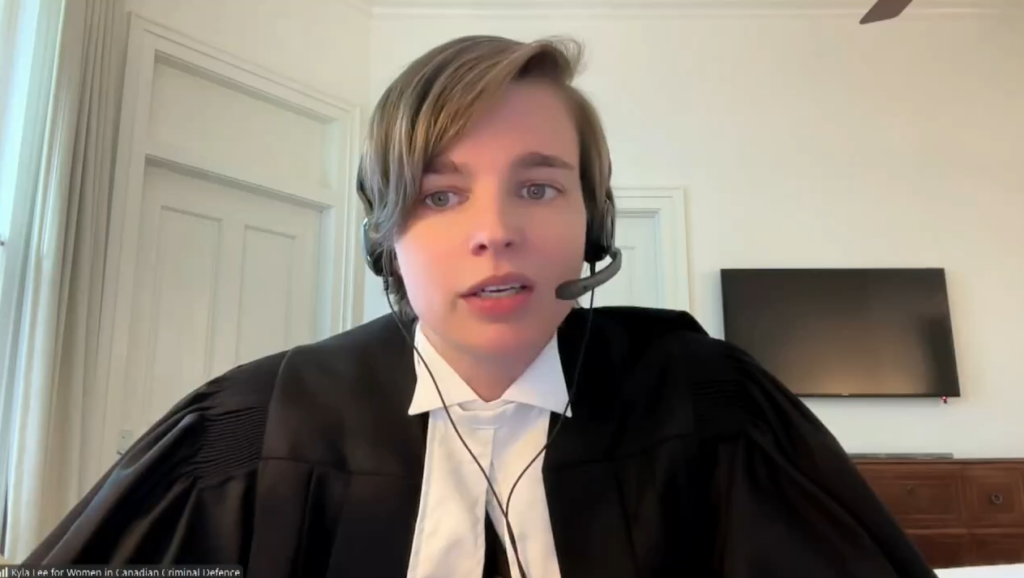
On February 17, 2026, I had the privilege of appearing before the Supreme Court of Canada as part of Women in Canadian Criminal Defence’s first intervention at the Court, in Megan Rae Korduner v His Majesty the King (SCC 41737).
WiCCD is an organization that has grown rapidly over the last four years, and it was a significant moment to bring the organization’s perspective to the Supreme Court, particularly in a case that raises fundamental questions about compelled speech, self-incrimination, and the right to silence under section 7 of the Charter.
The Legal Issue in Korduner
The appeal in Korduner concerns the extent to which statutorily compelled accident statements can be used in criminal investigations.
Ms. Korduner was involved in a serious motor vehicle accident. A police officer questioned her at the scene. During that interaction, she made statements indicating that she was intoxicated. Those statements were later relied upon to justify a breath demand. Ms. Korduner refused to provide a breath sample and was charged with refusal.
At trial, the judge concluded that her statements were compelled under Alberta’s Traffic Safety Act, and therefore protected by the principle against self-incrimination. The trial judge found that relying on those statements to justify a breath demand would violate section 7 of the Charter, and the charges were dismissed.
The Alberta Court of Appeal, in a split decision, disagreed and ordered a new trial. The Supreme Court of Canada has now granted leave to determine the proper constitutional boundaries.
At the centre of the case is section 320.31(9) of the Criminal Code, which provides that statements made to a peace officer, including statements compelled under provincial legislation, may be admissible for the limited purpose of establishing grounds for a demand.
The Supreme Court will decide whether this provision infringes section 7 of the Charter, and if so, whether that infringement can be justified under section 1.
WiCCD’s Intervention: Silence Is Not a Neutral Option
WiCCD intervened in this appeal because police interactions are inherently gendered, and that reality matters when courts assess the meaning and accessibility of the right to silence.
Much of constitutional doctrine is built on the assumption that individuals can simply remain silent when questioned by police. But in practice, silence is not equally available to everyone.
WiCCD advanced three main submissions.
1. The Section 7 Harm Occurs at the Moment of Compelled Speaking
WiCCD argued that the constitutional harm occurs when a person speaks under a reasonable belief that they must comply with legal authority, not later at trial.
Section 320.31(9) effectively permits compelled speech to be used to justify detention and demands. That is not a neutral evidentiary rule. It alters the constitutional boundary by converting compulsion into an investigative tool.
The harm is not cured by later evidentiary limits. It occurs at the moment the state obtains the compelled statement and uses it to escalate its power.
2. Silence Is Not Equally Available to Women in Practice
WiCCD’s second submission addressed the social reality of police encounters.
Women are socialized to comply, to assist, and to avoid appearing difficult, particularly when interacting with authority figures. Policing remains authority-driven, male-dominated, and paramilitary in its structure. That dynamic creates a social asymmetry that affects how women respond when questioned by police.
In many cases, silence is not treated as a neutral choice. It can carry real consequences, including being perceived as hostile, belligerent, uncooperative, or difficult.
For many women, what society labels “politeness” is experienced as risk management.
3. Gendered Pressures Create a Real Disadvantage in Practice
WiCCD argued that these gendered pressures have practical consequences. Women are more likely to respond to police questions, more likely to elaborate beyond what is asked, and more likely to provide information that exceeds what the law requires.
When a compelled accident-reporting regime is combined with criminal investigative tools, the result is predictable: compliance becomes self-incrimination.
Section 320.31(9) weaponizes this reality by allowing the state to use compelled statements to justify detention and demands, in circumstances where silence is not equally accessible.
Why This Case Matters Beyond Impaired Driving
Although Korduner arises from a driving law context, the implications are broader.
The Supreme Court’s decision will shape how compelled statements can be used in criminal investigations, and it will clarify the scope of the principle against self-incrimination under section 7 of the Charter. It will also determine whether legislatures can design statutory compulsion regimes that indirectly expand police investigative authority.
This is not a theoretical issue. It affects how regulatory reporting schemes interact with criminal law enforcement across many contexts.
A Significant Moment for WiCCD
WiCCD’s appearance at the Supreme Court of Canada was an important milestone for the organization. I was also notably the only woman who made oral submissions on the defence side in this appeal.
It was an honour to bring WiCCD’s perspective to the Court, and to remind the Court that police interactions are not neutral experiences, and that women and gender-diverse people experience police interactions differently.
Credits
Lead counsel for the WiCCD team who made the oral submissions was Kyla Lee, with incredible support from Megan Delaronde, Sweta Tejpal and Caleigh Glawson who wrote an incredible factum together, coached by Anita Szigeti.
Watch the Hearing
The webcast and case materials are available here:
https://www.scc-csc.ca/cases-dossiers/search-recherche/41737/
